
A 3D-printed bear on the front line against terrorist attacks
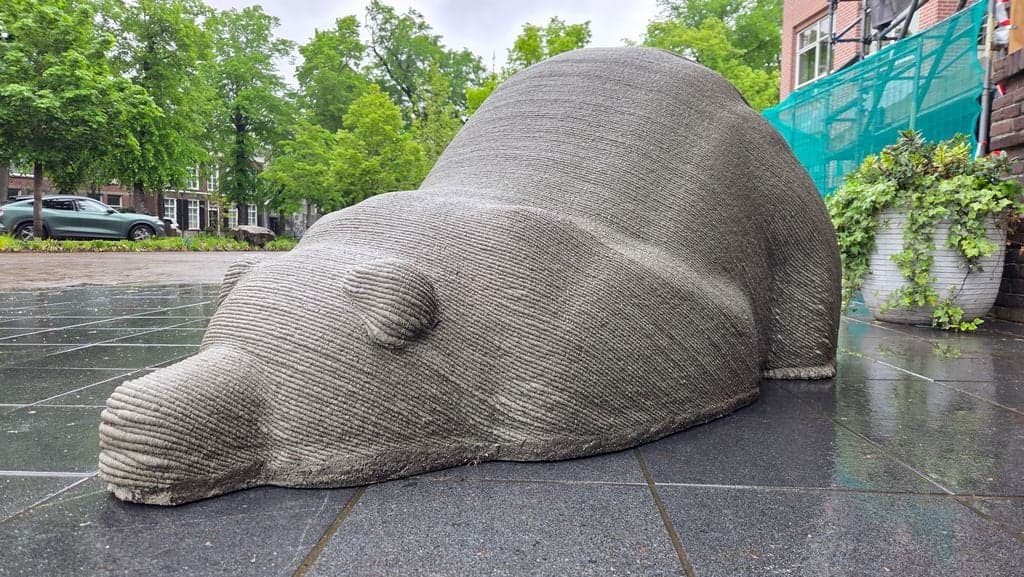
A Dutch designer has created a 3D-printed concrete bear that's both a public art piece and a counter-terrorism barrier.
Published on May 7, 2026
© Noël van Hooft - Omroep Brabant

Team IO+ selects and features the most important news stories on innovation and technology, carefully curated by our editors.
Across Europe's cities, public squares and event sites have become increasingly familiar with rows of grey concrete blocks, standing guard against the threat of vehicle-ramming attacks. Following a string of deadly incidents in Germany and other countries in recent years, these barriers have become a fixture of modern urban security. But one Dutch designer thinks safety and aesthetics don't have to be mutually exclusive — and he's built a 1,200-kilogram bear to prove it.
Paul Bas, a designer from Eindhoven, came up with the concept of the "beer op de weg" — Dutch for "bear in the road" — a 3D-printed concrete bear weighing 1,200 kilograms, intended as a more inviting alternative to standard anti-terrorism barriers.
The idea was born of frustration with the dull, bulky concrete blocks that routinely appear at public events to prevent vehicles or attackers from breaching road closures. "Those anti-terrorism or traffic-blocking objects are always clunky and soulless," Bas told Omroep Brabant. The bear, by contrast, is designed to charm. Standing 178 centimeters long, it invites people to sit on it and play — all while being sturdy enough to stop a car in its tracks.
A family of bears
Each bear can be produced by a 3D printer in just two hours, making the concept theoretically scalable, though the weight and shape pose challenges for stacking and frequent relocation. Bas sees this not as a flaw but as a feature: the bears are intended to become semi-permanent fixtures in city spaces, deployed to active duty when events require it.
The concept is currently being tested in the town of Valkenswaard, in the Dutch province of North Brabant. A student named Coby Werson brought one of the bears to the town's central market square as part of her graduation project, where it is gathering public feedback via a QR code. Her vision goes further than a single bear: she hopes to eventually place an entire bear family throughout Valkenswaard — complete with baby bears — each with a permanent spot in the city, ready to be mobilized for safety purposes when needed.
Crowd protection against terrorist attacks
The timing feels relevant. In recent years, vehicle-ramming attacks at Christmas markets and public gatherings in Germany have reignited debate across Europe about how to protect crowded spaces without turning them into fortresses. Critics of current solutions argue that heavy-handed security infrastructure creates an atmosphere of fear, eroding the very sense of openness that public spaces are meant to embody. Bas's bears offer a different proposition: security that blends into the cityscape, that children can climb on, and that locals might actually grow fond of.
Conversations with local municipalities about permanently placing the bears are underway, though no orders have come in yet — something Bas admits has been a disappointment. Navigating the slow-moving bureaucracy of local government, he notes, is a different challenge from the design work itself.
Still, the bear is out there on the market square, its concrete snout pointed toward the road. Whether it reshapes how European cities think about public safety — one cuddly barricade at a time — remains to be seen.