
After €200M round, EUCLYD teams with FMC on sovereign AI
Dutch chipmaker EUCLYD pairs fresh €200M funding with a new memory partnership, aiming to cut AI's power and cost bottlenecks.
Published on September 16, 2026
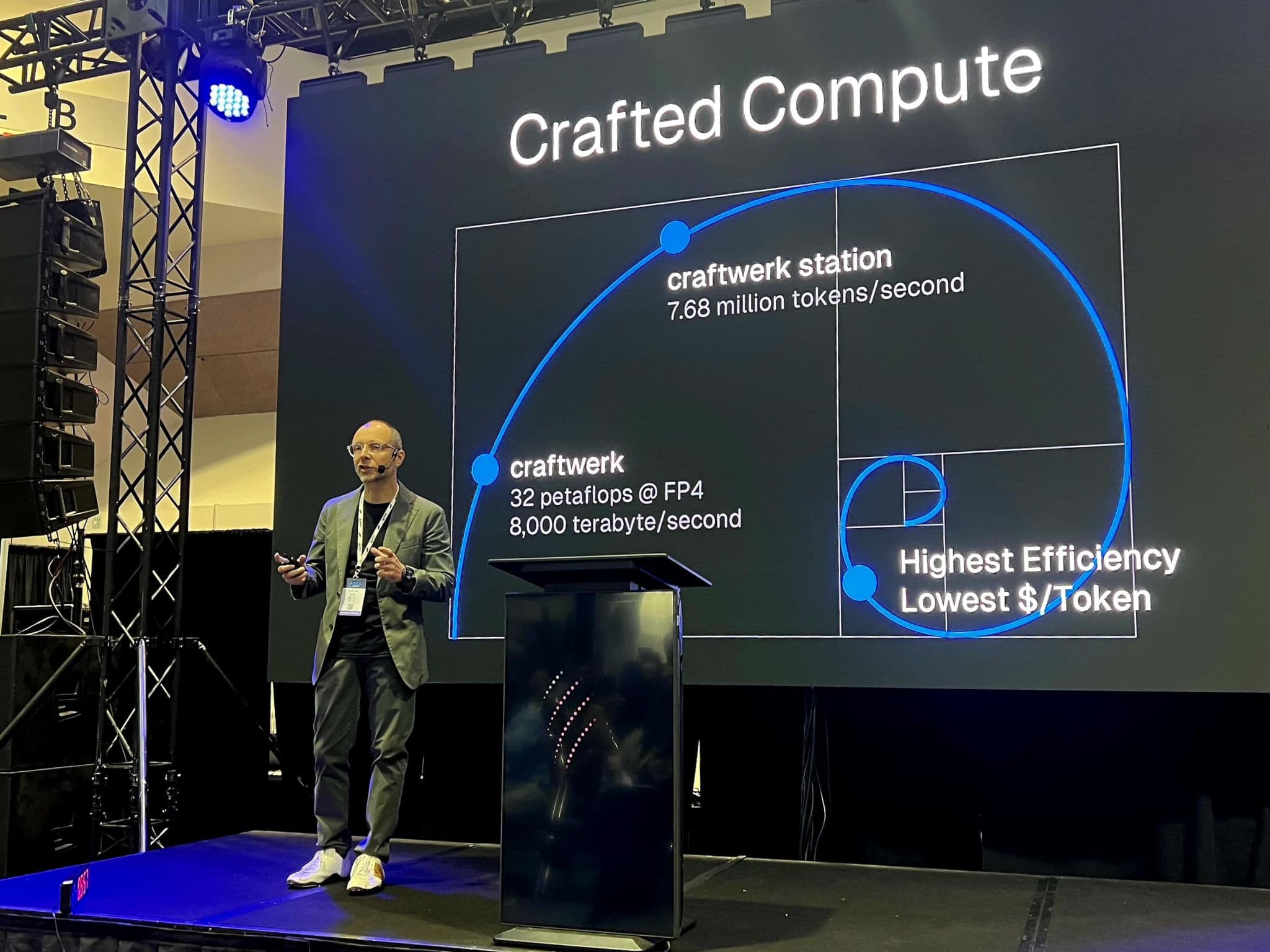
Euclyd's Ingolf Held at the AI Infra Summit in Santa Clara, California © Euclyd

Team IO+ selects and features the most important news stories on innovation and technology, carefully curated by our editors.
Eindhoven-based semiconductor startup EUCLYD is moving fast. After closing a Series A round of more than €200 million, the company announced a new strategic collaboration with Ferroelectric Memory Company (FMC), a Dresden-based memory specialist, aimed at building secure, "sovereign" AI infrastructure for Europe.
The partnership, unveiled at the AI Infra Summit 2026 in Santa Clara, California, pairs EUCLYD's compute and AI-factory architecture with FMC's persistent nvDRAM+ and high-density Cache+ memory technologies. The two companies — which together have raised more than €300 million — say the goal is to keep data closer to compute, cutting the energy and cost penalties that come from constantly shuttling information between chips and memory. Early integration work has already begun, with commercial products targeted for 2029.
The memory bottleneck
The case for urgency is built into the FMC deal's own framing. By 2028, AI inference — not training — is expected to become the largest single driver of power consumption in data centers, and power has already emerged as the binding constraint on AI infrastructure growth. Nearly half of global data-center projects due to finish this year are facing delays tied to power limits, and more than $130 billion in U.S. projects were blocked or delayed in the first quarter of 2026 alone, largely over energy costs and local opposition to construction.
EUCLYD founder and CEO Bernardo Kastrup framed the FMC tie-up as filling a gap in Europe's industrial capabilities, arguing that the region cannot achieve AI leadership without strength across the full infrastructure stack, from compute to memory to systems. FMC CEO Thomas Rueckes echoed that memory has become one of the defining bottlenecks in modern AI systems, and pointed to new possibilities in areas like model-state management and KV-cache handling once compute and persistent memory are tightly integrated.
From Europe to the world
Beyond Europe, the companies argue their approach — emphasizing data residency and keeping sensitive information off public cloud infrastructure — could appeal to any organization or nation with similar requirements, including regulated industries such as defense, banking and healthcare.
Combined with the fresh capital and Wennink's arrival, the FMC partnership gives EUCLYD a fuller story: money, industry credibility, and now a memory partner to help it compete on the physical constraints — power and data movement — that are increasingly shaping the AI infrastructure race.