
AI startups refine their pitches: ‘Show what you stand for’
How can AI startups convince customers and investors? The AI Pitch Competition finalists refine their pitches ahead of the final.
Published on October 28, 2026
AI Pitch Competition
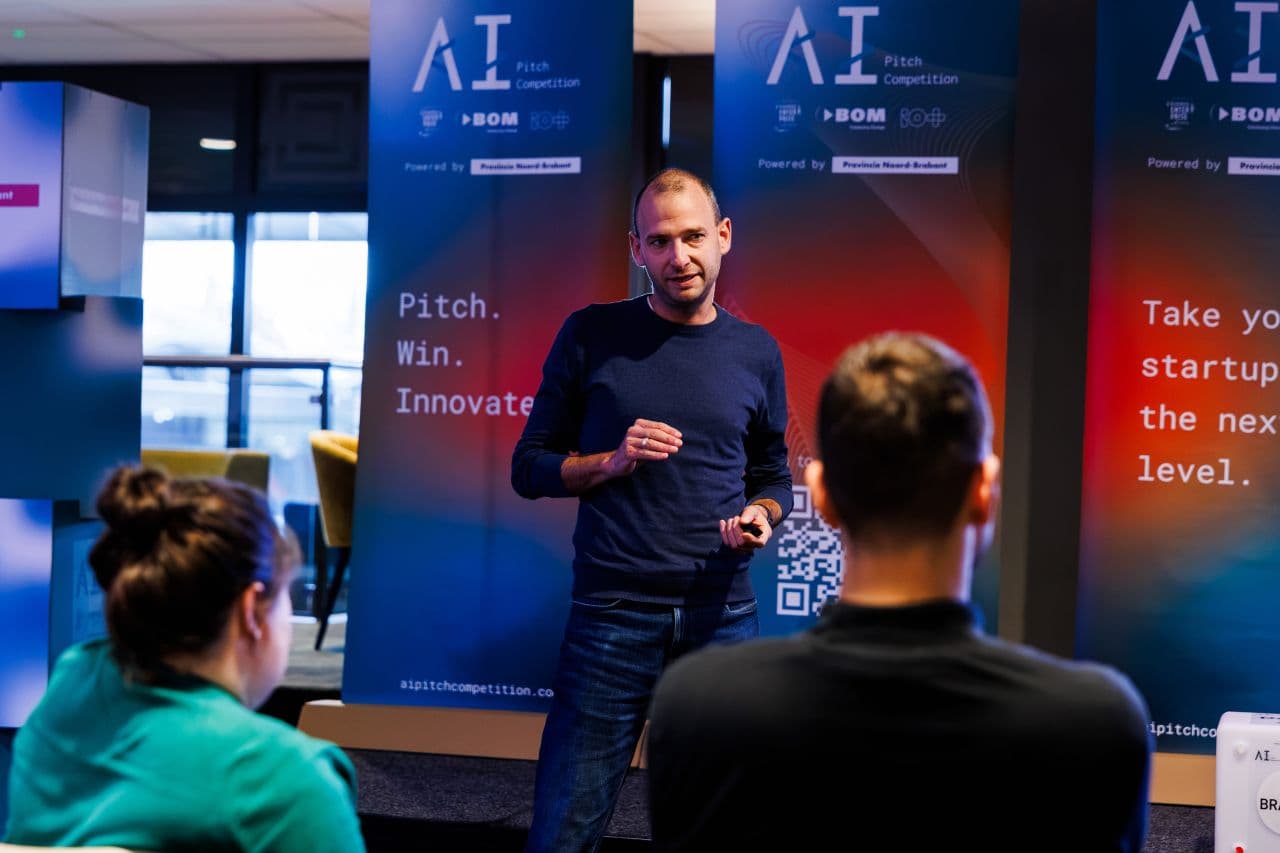
In the run-up to the AI Pitch Competition final, the eight finalists are refining their pitches. During the How to Pitch workshop at Koning Willem II Stadium last Tuesday, they worked with coaches to sharpen their stories, communicate the value of their AI solutions and make the most of their pitches.
At the opening of the workshop, Liesje Goldschmidt, Marketing & Business Development Director at Erasmus Enterprise and one of the organisers of the AI Pitch Competition, emphasises that the competition is about more than winning the grand prize. Pitching also gives the finalists opportunities to meet potential customers, partners and investors and gather feedback. “Be open to feedback, talk to each other and, above all, learn together. Get your key points across in your pitch and show what you stand for,” she advises.
Goldschmidt also points out that a pitch does not end when the presentation is over. What matters is what an entrepreneur achieves afterwards. Interest from a potential customer or investor can be the start of a conversation that leads to a collaboration.
AI Pitch Competition
The AI Pitch Competition is a Brabant initiative aimed at showcasing the most innovative AI solutions and allowing startups to present their ideas, connect with industry leaders, and accelerate their growth. The competition is taking place again this year. Nine ambitious AI startups have been selected. The finale will be held on November 12, 2026.
Human connection
During his inspiration talk, Guido Gageldonk, venture developer at the Brabant Development Agency (BOM), explains that AI is not just his job but also a hobby. He describes it as his new form of digital Lego: experimenting and discovering what is possible. During the autumn break, he built a computer game in just one week using AI agents. It was an idea he had had since he was twelve. “I thought: fuck it, I’ll give it a try.”
According to Gageldonk, startups can use AI for far more than just programming. The technology can also help test ideas, prepare for customer conversations and organise a business. However, AI does not change the fundamentals of entrepreneurship. “We need to keep developing our technology, find the right customer and a problem worth solving, manage our team and keep an eye on our finances.”
One major pitfall, he says, is that entrepreneurs fall in love with their own technology, while the market is not necessarily convinced. A working solution or pilot does not mean customers are willing to pay for it. That is why startups need to keep testing their assumptions and talking to potential customers. AI can help, but human contact remains important. “It’s good to keep talking to other people and to have people around you who keep you sharp while you’re working with all these bots.”
Thirty seconds to get to the point
After the inspiration session, it is time to put theory into practice. The participants worked on their pitches through a series of exercises. In each round, they are paired with a different coach, so they get feedback from different perspectives.
In the first exercise, they have just thirty seconds to pitch their startup. The time limit forces them to make choices: what does the audience absolutely need to know about their company, and what can be left out? They then review their pitch with their coach, discussing what stands out and what could be improved. Next, the participants record their pitch again and watch themselves back. What works well, and what could be sharper? Reviewing their own presentations also helps them become more aware of how they communicate their story.
The exercises gave the finalists several insights into how to strengthen their pitches. They learned to make complex technology understandable to an audience without the same technical knowledge, clarify why investors should choose their startup and explain what sets their solution apart from competitors. Another key takeaway was the importance of focus: with limited time, founders need to find the right balance between explaining their technology, demonstrating its value and getting their core message across.
More than a presentation exercise
The different insights point to the same challenge: a pitch needs to provide enough information to make a company understandable and appealing, without losing the core message in too much detail.
One of the coaches, Harm de Bruin, adds a personal dimension: entrepreneurs should also show why they believe in their business. Passion and personality can strengthen a pitch. Like Gageldonk, he emphasises that a startup is more than technology. A convincing pitch explains what problem the solution addresses, who it is for and what value it offers.
For the finalists, the workshop is therefore more than a presentation exercise. They learn not only how to tell their story in thirty seconds, but also which questions to ask themselves before trying to convince a customer or investor.
Winning the AI Pitch Competition is one possible goal. But, as Goldschmidt makes clear at the start of the day, there are other opportunities too. A conversation that leads to a collaboration, a new partner or a potential customer can be just as valuable.