
ASML’s major chipmaking breakthrough boosts output 50%
By doubling the speed of molten tin droplets used to generate the light, ASML can significantly speed up production.
Published on February 24, 2026
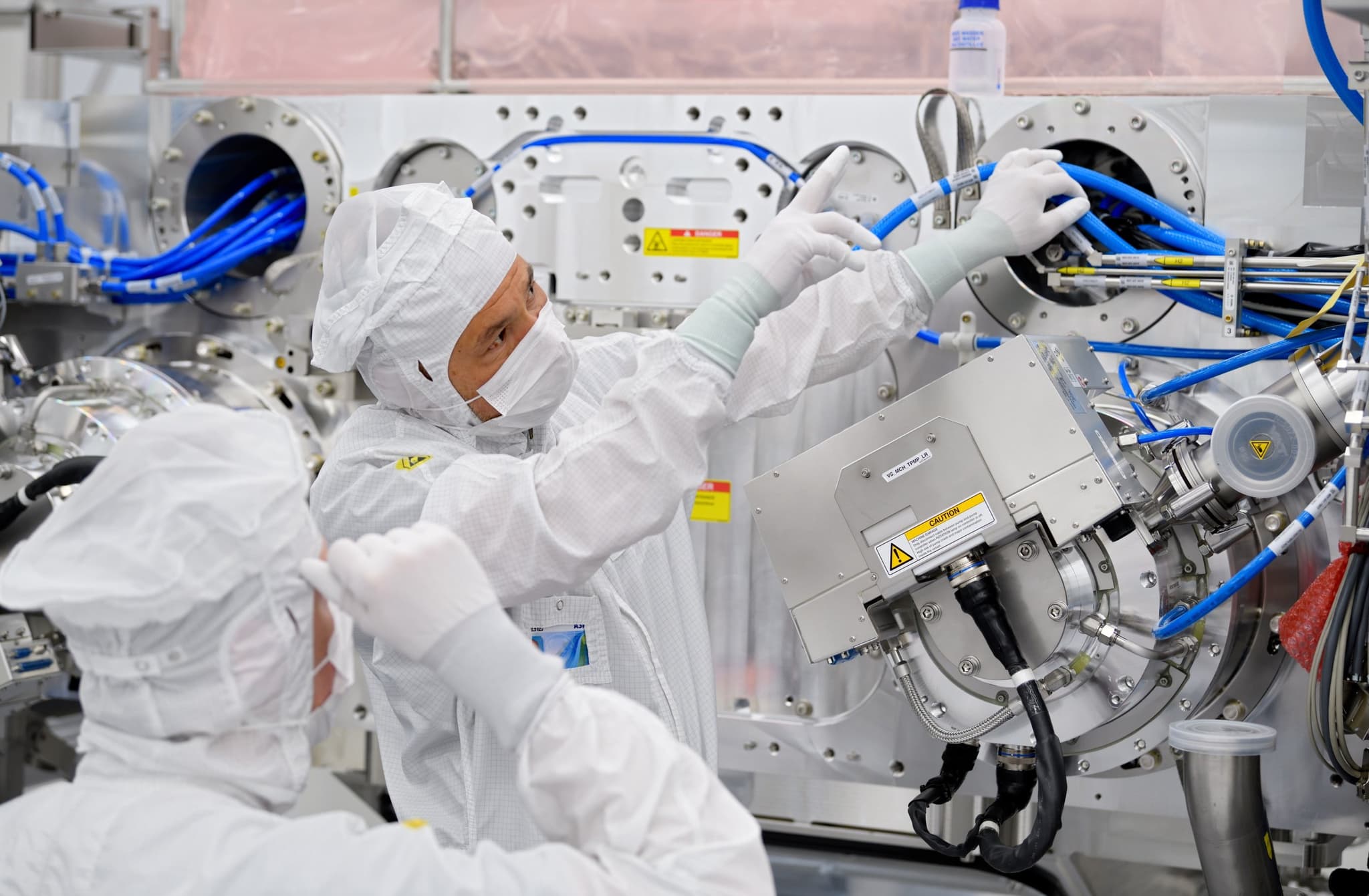
Research and Development, © ASML

Team IO+ selects and features the most important news stories on innovation and technology, carefully curated by our editors.
By doubling the speed at which tiny droplets of molten tin (liquid metal) are fired, ASML has developed a 1,000-watt light source. This powerful light is used to “print” extremely small patterns onto computer chips. The stronger the light, the faster and more efficiently chips can be produced. According to the company, this improvement could increase chip production by about 50 percent by 2030.
A major step forward in chipmaking
These machines use something called Extreme Ultraviolet light, or EUV. This is a special type of light with an extremely short wavelength. Because of that, it can “draw” incredibly tiny patterns on silicon wafers — the thin discs that chips are made from. The more powerful the light source, the faster chips can be produced.
The breakthrough is the result of advanced physics and precision engineering. The system fires tiny droplets of molten tin (liquid metal) and hits them with lasers to generate the EUV light. Special mirrors — supplied by the German company Carl Zeiss — then capture and carefully direct that powerful light so it can be used to print chip patterns with extreme accuracy.
It is a significant step that strengthens ASML’s position in the global semiconductor industry — the industry that makes the chips used in smartphones, cars, AI systems and supercomputers.
Throughput gains and economic impact
Currently, ASML’s machines process approximately 220 wafers per hour. With the implementation of the 1,000-watt light source, the company projects that factories will be able to process 330 wafers per hour by the end of the decade. This represents a production increase of 50 per cent.
Geopolitical friction
This technological leap serves as a strategic bulwark against a backdrop of intensifying geopolitical friction and commercial rivalry. While ASML currently stands as the sole global manufacturer of commercial EUV machines, the United States government has restricted shipments to China, prompting Beijing to accelerate its own development efforts. Simultaneously, American startups such as Substrate and xLight are actively developing competing technologies.
A robust system
ASML’s lead technologist Michael Purvis dismissed the notion that the new power level is experimental, asserting it is ‘not a parlor trick’ but a robust system capable of operating under customer requirements.