
Caravan goes electric: Lume Ranger rides a new trend
Lume Traveler aims to make camping with an electric car more accessible.
Published on November 3, 2026
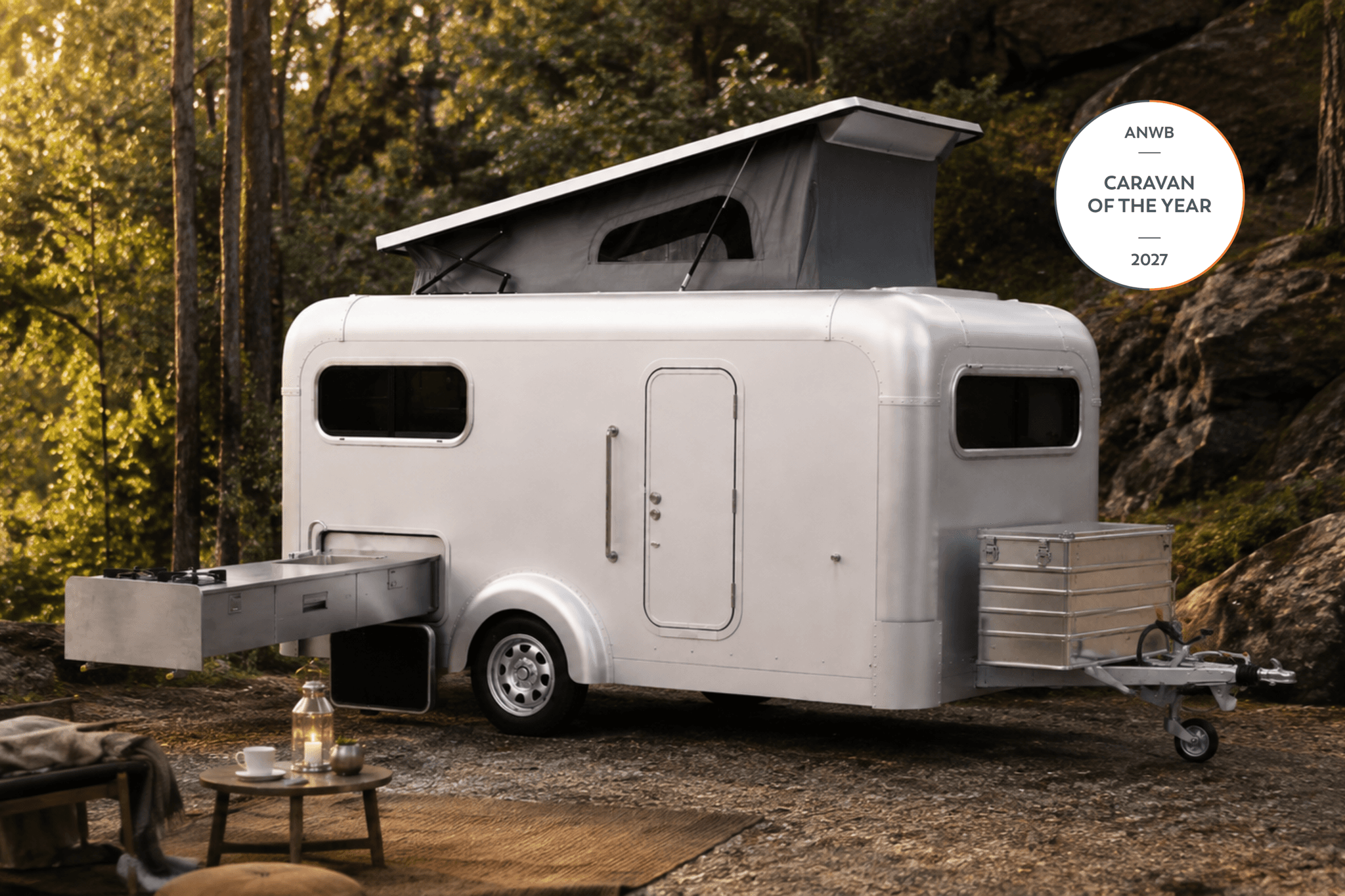
Lume Ranger

Team IO+ selects and features the most important news stories on innovation and technology, carefully curated by our editors.
Electric cars are changing the design of travel trailers. With a curb weight of 1,150 kilograms, a retractable roof, and an aluminum frame, travel trailer manufacturer Lume Traveler aims to make camping with an electric car more accessible. The Lume Ranger was named ANWB Caravan of the Year this year. During the Kampeer & Caravan Jaarbeurs in Utrecht, Lume Traveler noticed that interest in compact caravans designed to be towed by electric cars is growing.
The rise of electric cars is also changing the requirements for caravans. It’s not just weight that matters: height and shape also influence energy consumption. Aerodynamic drag can limit an electric car’s range. Lume Traveler is responding to this with the Ranger, a compact caravan designed to be lightweight without compromising on comfort or build quality.
Smart choice of materials
The Ranger weighs 1,150 kilograms when empty. The maximum allowable weight is 1,500 kilograms. Including the drawbar, the caravan is 5.19 meters long and 2.04 meters wide. According to Max van Veen, commercial director of Lume Traveler, the brand wanted to develop a compact caravan without sacrificing its signature design and comfort. “We’re seeing that caravans need to become lighter and lighter, partly due to the rise of electric cars. But that often comes at the expense of quality and the materials used. We wanted to take a different approach.”
Lume Traveler did not reduce the weight by omitting features. “Instead, we focused specifically on the construction and choice of materials during the design process,” says Van Veen. The walls and roof are made of aluminum sandwich panels. “These panels provide better insulation than many traditional trailer constructions. They don’t absorb moisture and are sturdy. As a result, the exterior walls and the roof itself can serve as load-bearing elements.”
Consequently, the interior doesn’t need to contribute as much to the structure’s strength, leaving room for comfort and ease of use. This allows for features such as a teak floor and an iroko wood table.
Reducing energy consumption
The low weight is only part of the story. The compact shape and limited height are also designed to reduce energy consumption while driving. To this end, the Ranger is equipped with a pop-up roof, which is folded down during transport and provides extra headroom at the campsite. The low profile and rounded shapes at the front are designed to channel air past the caravan and minimize drag.
The pop-up roof also presented a technical challenge. A large roof opening, after all, affects the structural integrity of the entire vehicle. According to Van Veen, the body remains sturdy despite that opening.
Exactly how much energy the Ranger saves in practice has not yet been determined. “Actual consumption depends, among other things, on the towing vehicle, the load, the speed, the weather, and the route.” An electric car must also have sufficient towing capacity and meet the requirements for maximum towing weight and ball pressure. “With a maximum allowable trailer weight of 1,500 kilograms, the Ranger is therefore not suitable for every electric car.”
Planning and charging stops
Van Veen expects that traveling with a caravan towed by an electric car will require more planning and charging stops than driving without a trailer. In his view, that doesn’t necessarily have to be a disadvantage. “While charging, you have your own toilet, seating area, and kitchen with you. So a charging stop with the Lume towed behind the car doesn’t have to be a chore at all.”
He also expects that charging stations will increasingly be equipped with longer parking spaces, so that drivers won’t have to unhitch their caravans first in order to charge. “That does, however, require adjustments to the charging infrastructure.”
Greater interest but also a higher price
During the Kampeer & Caravan Jaarbeurs in Utrecht, which took place from September 30 through October 4, Lume Traveler reported seeing a lot of interest in compact caravans that can be towed behind an electric car. “With the Adventure, we’ve already seen that there’s demand for smaller models. The introduction of the Ranger and the ‘Caravan of the Year’ title have further increased that interest.”
The Ranger does come with a hefty price tag, however. With a starting price of 49,950 euros, it is more expensive than many traditional caravans. According to Van Veen, price is the main factor potential buyers consider. “The manufacturer counters this with high-quality materials, meticulous craftsmanship, and a construction designed to last.”
The ANWB jury also highlighted a few practical considerations during the selection process. Although the jury praised the design, technology, use of materials, and finish, there were also some reservations: the entry door is small, storage space is limited, and cooking is only possible outdoors.
Traveling lighter isn’t automatically more sustainable
Lume Traveler views the use of wood and aluminum and the intended long service life as part of its sustainability approach. The lower weight and compact design can also help reduce energy consumption while driving. Van Veen does, however, add a caveat: “A lower weight and a compact design alone don’t say enough about the overall environmental impact.”
The production and origin of materials, the towing vehicle used, and the total travel distance also play a role. By choosing materials and a construction designed to last, Lume Traveler is at least attempting to account for the caravan’s environmental impact across multiple aspects.
For some travelers, camping with a caravan can be an alternative to a vacation by plane, but it isn’t automatically more environmentally friendly. “That depends on how and how far someone travels and what mode of transportation is used for that,” Van Veen emphasizes.