
Dutch manufacturing industry: ‘10 years to turn the tide’
Without automation, the manufacturing industry in the Netherlands will disappear.
Published on April 7, 2026
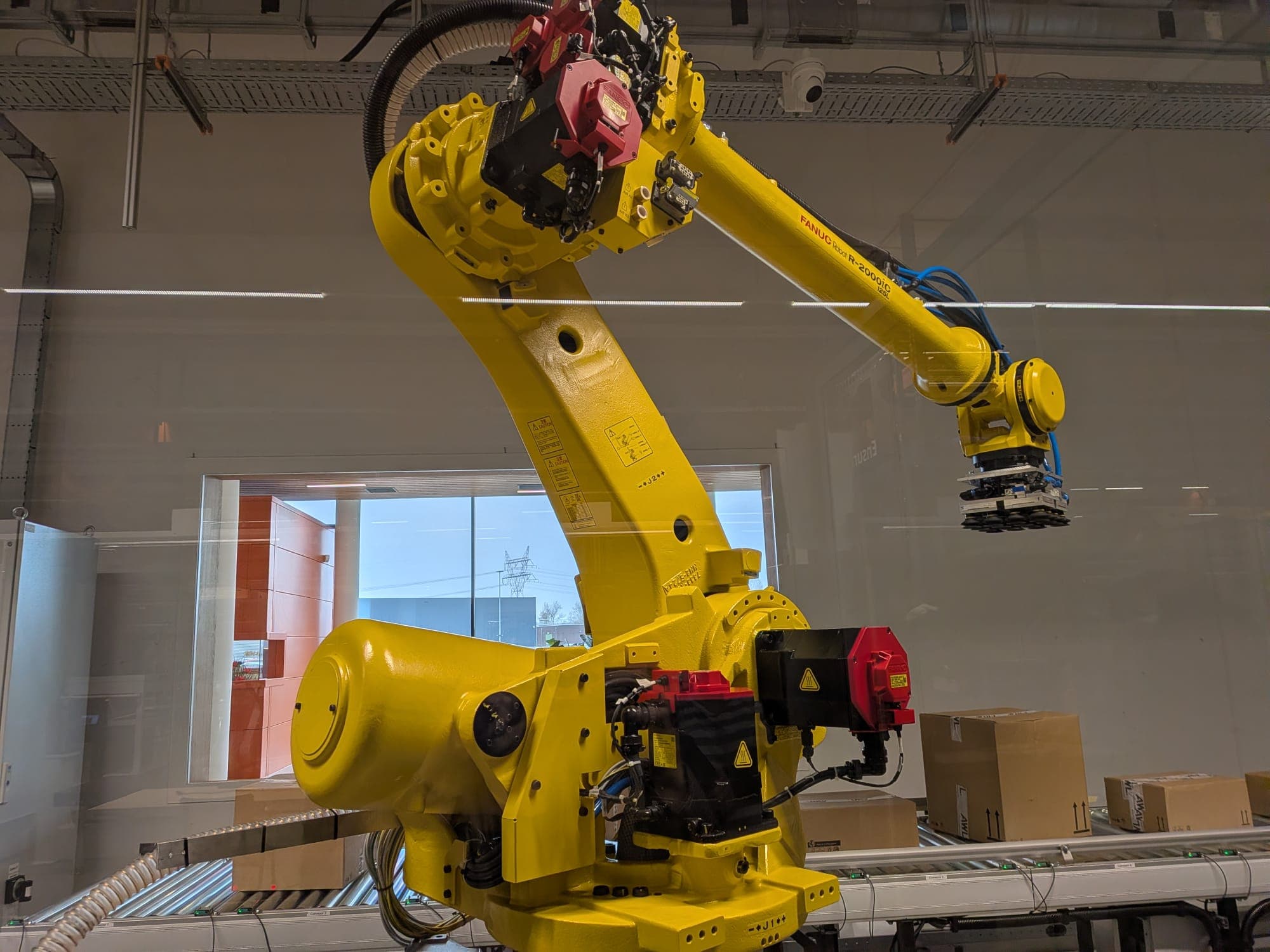
A machine at AWL

Our DATA+ expert and Editor-in-Chief, Elcke Vels, explores AI, cyber security, and Dutch innovation. Her "What if..." column imagines bold scenarios beyond the norm.
Last week, alarm bells rang at machine manufacturer AWL in Harderwijk. IO+ attended a press event at the heart of the robotics world. Journalists were given a tour of advanced robots for the manufacturing industry, but the gathering had a serious undertone. TNO presented a new report with a stark, clear message: without automation, the manufacturing industry in the Netherlands will disappear.
The manufacturing industry accounts for seven percent of our gross domestic product. The sector is essential for financing all kinds of societal transitions, from energy to healthcare. However, during the meeting, Mark Courage and Claire Stolwijk of TNO painted a picture of a Dutch manufacturing sector facing major challenges. An aging population, persistent labor shortages, and high labor costs are putting the sector under severe pressure, while productivity growth is stagnating.
Productivity must increase drastically to remain relevant on the global stage. How can we tackle this? Through robots, that is the message. Globally, the Netherlands ranks twelfth in terms of robotization per 10,000 employees, Stolwijk explains. That may sound good, but what stands out is: “Asia is clearly in the lead and is rapidly increasing that lead.”
Absolute necessity
TNO’s warning is therefore crystal clear. We have a maximum of ten years left to turn the tide. The consequences of inaction will otherwise soon be felt, Stolwijk continues. Within two years, labor shortages will already lead to higher costs and less efficient production. Within five years, the Netherlands will miss out on productivity growth, and outdated production lines will become a serious disadvantage. “And in the long term, irreversible damage looms: entire factories forced to close.”
Opportunities in the Netherlands
There are opportunities within our borders. The Netherlands excels particularly in manufacturing complex products in relatively small batches. This specialization gives us strategic control points in the global economy. Examples include ASML’s chip machines and advanced satellite communications. Production must remain physically in the Netherlands and Europe to maintain this control. “This will only work if we produce more cost-effectively than the rest of the world,” said Courage. Robotization is therefore the only answer.
The theory sounds logical; practice confirms it. In addition to the well-known successes of giants like ASML, Stolwijk cited a number of impressive examples from other Dutch companies.
“Bed manufacturer Auping saw its production capacity increase by 48 percent through the use of robots. Fluidics Instruments used to produce 300 nozzles per week. Thanks to robotization, that number is now 20,000 per week.”
AI: a unique opportunity
Implementing automation tends to go relatively smoothly for a multinational corporation. For small and medium-sized enterprises (SMEs), which spend a great deal of time just trying to stay afloat, it’s a completely different story. How can we ensure that startups implement robotics? According to TNO researchers, AI can significantly accelerate adoption among companies of all sizes. In the past, programming a robotic arm was a time-consuming process. A specialized programmer often spent weeks writing complex code. That is now a thing of the past. “The integration of large language models makes robots much more accessible. Modern systems use platforms that require little to no code. An operator on the factory floor can now give instructions to a robot using natural speech,” says Courage.
Robotization in education
However, new technology alone is not enough to save the manufacturing industry. We urgently need people who understand how to work with robots. Education plays an absolutely key role in this. Robotics has now become a structural and mandatory component of various non-technical programs. Examples include the VMBO Care and Welfare program and various advanced medical training programs. AWL also works closely with various educational institutions and supervises dozens of interns, the machine builder announced during the press session.
Taking the lead
What’s next? TNO advocates for a national robotization agenda with clear, long-term goals. This agenda must take the central lead and enforce standardization. Courage: “A national agenda provides direction, accelerates adoption, and ensures that companies—both large and small—gain access to technology that will shape their future. Only in this way will the Netherlands remain a creator, rather than a dependent consumer.”
Such an agenda would, for example, involve exploring robotization in education, so that future employees can work with robotics. The Netherlands must also become Europe’s premier testing ground for smart, flexible robotization. “And,” adds Stolwijk, “SMEs will get a boost through field labs, vouchers, and affordable models such as Robotics-as-a-Service.”
What needs to be done is clear. Now it’s time for implementation. Courage concludes: “The Netherlands must transform from a slow city bike into a fast racing bike. That requires focus and collaboration: government, industry, and education must join forces. We must stop reinventing the wheel everywhere and instead ensure that the wheel is created in one place, the frame in another, and that together we build a single powerful racing bike to win on the international stage.”
The next ten years will determine our global position.