
Dutch science grows, spin-offs stall
Dutch research is as lively as ever, yet it hardly converts into impactful companies.
Published on October 8, 2026
© Techleap

Team IO+ selects and features the most important news stories on innovation and technology, carefully curated by our editors.
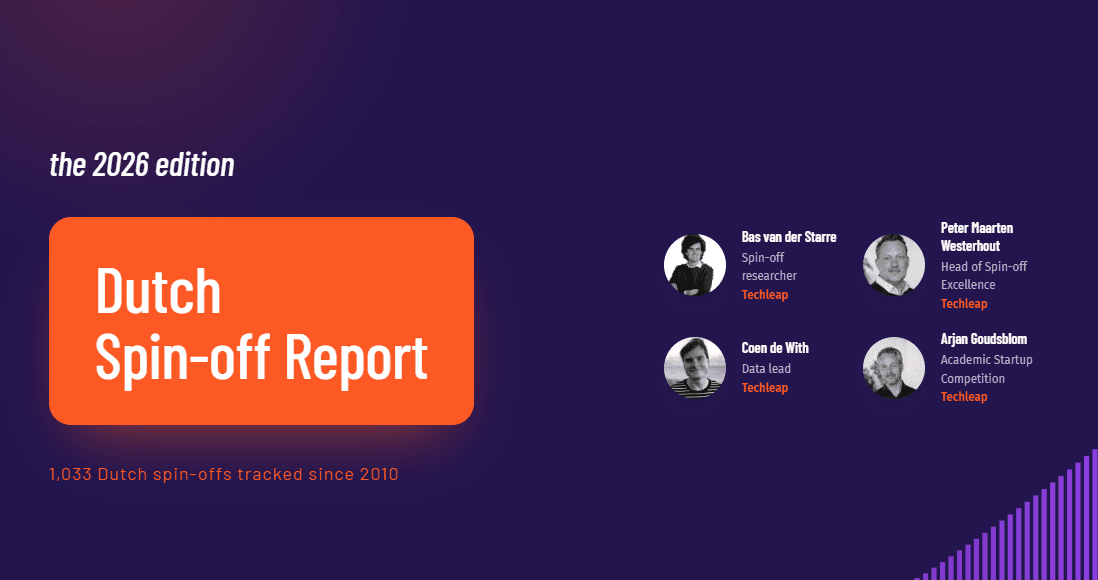
The Netherlands is producing more research than ever, but it's not producing more companies. That is the central finding of the Dutch Spin-off Report 2026, published by startup ecosystem driver Techleap this week. Between 2015 and 2023, researchers at Dutch universities and university medical centres grew by 28%, while new academic spin-offs stayed flat at around 65 a year.
The report tracks 1,033 spin-offs incorporated since 2010. It draws on Techleap's Academic Venture Monitor, a national dataset supplied by knowledge institutions and enriched with Chamber of Commerce (KvK) and Dealroom data. Techleap defines a spin-off as a scalable venture built on scientific results from a public research institute.
Small in number, big in capital
Spin-offs punch above their weight. One in fourteen Dutch startups is an academic spin-off; in deep tech it is one in four, and in biotech almost half. Together they employ around 11,000 people.
In 2025, spin-offs raised €549 million in venture capital, more than a fifth of all VC going to Dutch startups, while making up just 7% of them. Since 2010, they have attracted €3.2 billion, excluding grants, loans and IPOs.
They also reach funding milestones more often: 18% have raised at least €1 million, against 9% of other startups. Among deep tech spin-offs, 45% have crossed that line, and 19% have passed €10 million.
A pipeline that isn't keeping pace
The Netherlands produces one spin-off a year for every 860 full-time research staff. Trends differ sharply by discipline: spin-offs from the natural sciences, including mathematics and computer science, have tripled since 2015, while those from the health sciences have fallen by 58%.
Techleap points to ETH Zürich to show that stagnation is not inevitable. There, researcher numbers grew 13% over the same period while spin-offs rose 68%. Had Dutch spin-off creation merely kept pace with researcher growth, the country would now see about 88 a year.
Lagging abroad, and not getting faster
Internationally, the picture is less flattering. Of the nine countries compared, the Netherlands has the lowest share of spin-offs raising €1 million within five years of founding, in biotech, deep tech and other sectors alike.
Speed is not improving either. For successful spin-offs founded between 2015 and 2019, the median time to €1 million was 29 months; for the 2020–2021 cohort it was 35 months. Dutch spin-offs trail front-runner Belgium by up to 13 months.
From diagnosis to action
The report arrives weeks after the cabinet announced on Prinsjesdag that it will spend €30 million a year to strengthen spin-off creation at universities. Techleap presents its findings as the evidence base for that effort, and sees room to quadruple the impact of Dutch spin-offs.
Its recommendations: knowledge institutions should spot promising research earlier, better coach scientist-founders, and pair them with experienced entrepreneurs, supported by transparent, standardised processes for starting companies. Part of that work runs through Techleap's Spin-off Factory, which is building an experienced-founder network, a guide for researchers and a benchmark of deal terms between institutions and startups. Follow-up research will look at how intellectual-property agreements affect later growth.