
Einstein telescope debate: a triangle or an L after all?
The Einstein Telescope is designed to accurately detect gravitational waves.
Published on November 12, 2026
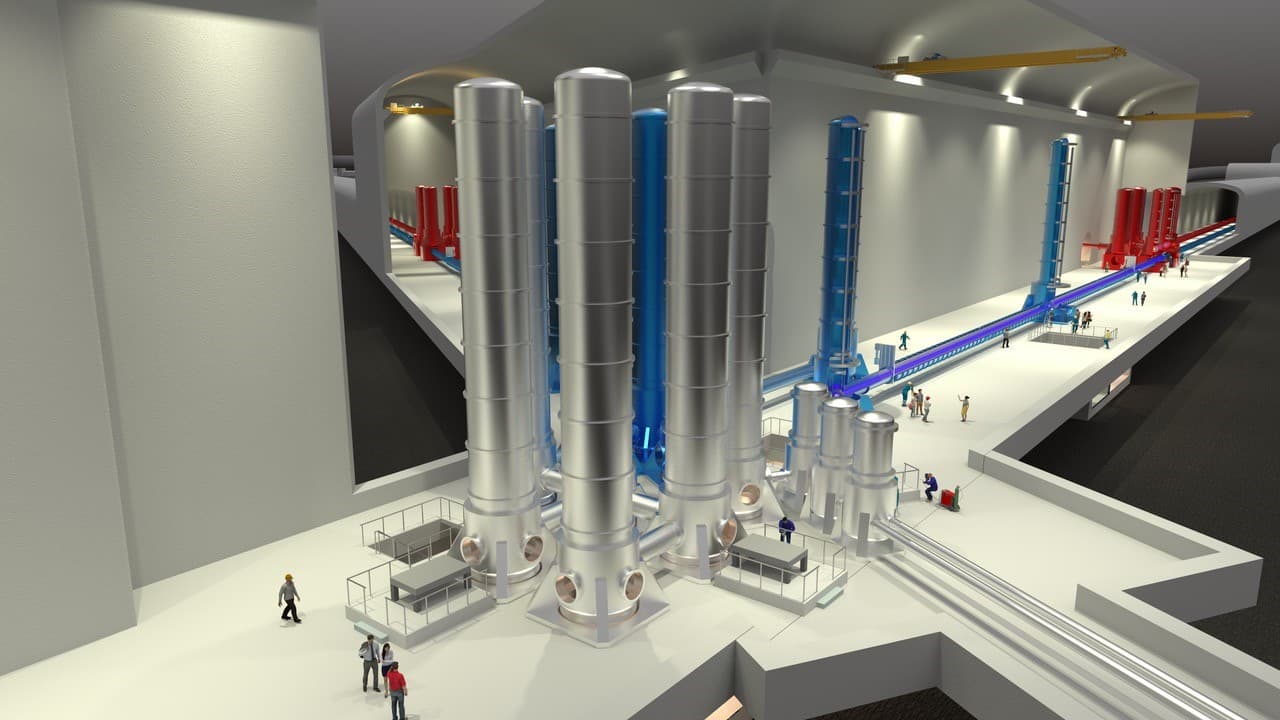
Einstein Telescope

Our DATA+ expert and Editor-in-Chief, Elcke Vels, explores AI, cyber security, and Dutch innovation. Her "What if..." column imagines bold scenarios beyond the norm.
The Einstein Telescope, a measuring instrument that will be located 250 meters underground, is expected to be able to measure gravitational waves much more accurately than current detectors. But before construction can begin, a number of important questions must be answered: where will the instrument be located, and will the telescope take the form of a triangle, or will there be two L-shaped detectors at different locations? IO+ spoke with two people involved in the Einstein Telescope Pathfinder project about the location, the design, and the development of the necessary technology.
The Einstein Telescope is designed to help scientists answer fundamental questions about the universe. What happens when black holes collide? And what can gravitational waves tell us about the history of the universe?
Although construction of the telescope has yet to begin, the necessary technology is already being actively developed and tested at the Einstein Telescope Pathfinder. The Pathfinder is a research facility in Maastricht where scientists develop and test technology for the next generation of gravitational-wave detectors, including the Einstein Telescope. The facility was established by an international consortium, with Maastricht University and Nikhef among its key partners.
During an extensive tour of the campus, IO+ spoke at the Pathfinder with Henk Schroen, communications manager at the Einstein Telescope EMR project office, and Gideon Koekoek, associate professor of physics at Maastricht University, about the Pathfinder and the future Einstein Telescope itself.
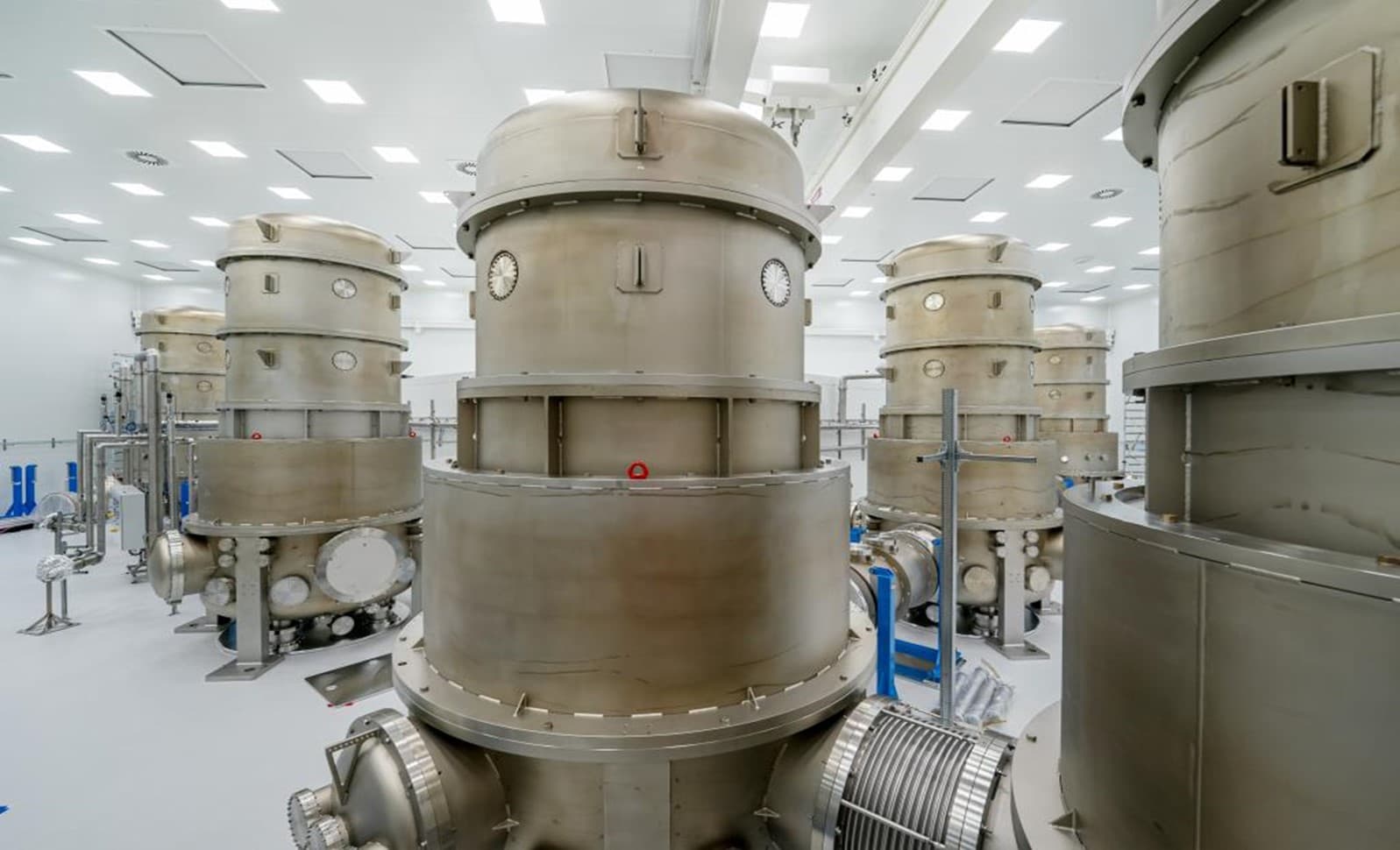
The ETpathfinder
Measuring gravitational waves: a crash course
Before Koekoek delves into the discussion about the telescope’s location and design, he first explains—as befits a physicist—how the instrument is supposed to work. “Gravitational waves are measured using lasers and mirrors,” he begins. “A laser beam is directed at a mirror and reflected back. By measuring how long the light takes to travel, researchers can determine whether the distance between the laser and the mirror changes.” This is done using two laser beams that meet upon their return. Koekoek explains that the measuring instrument is calibrated so that the light waves normally cancel each other out. But when a gravitational wave passes by, the mirrors shift a fraction of a position. This changes the distance the light travels, and the light waves no longer align precisely with each other. “The light doesn’t completely cancel each other out, but instead reinforces each other. That minuscule change then makes the gravitational wave measurable.”
The challenge: ruling out all other vibrations
Measurable, indeed, but that certainly doesn’t happen on its own. The measurement is extremely sensitive. The mirrors must move only in response to a passing gravitational wave, not due to other environmental factors. “It’s not just earthquakes that cause such vibrations; human activity also plays a role. In addition, the laser and the light particles themselves generate a form of noise,” Koekoek explains.
The Pathfinder is being used to test various techniques needed for the Einstein Telescope, including methods for suppressing noise. Among other things, scientists are investigating how to cool mirrors to extremely low temperatures and how to use special coatings and lasers to measure light as accurately as possible. They are also testing vacuum systems, highly sensitive sensors, and software that controls the various components.
Triangle or L-shape: what the science says
Then it’s time to broach the topic of the Einstein Telescope’s shape. The Pathfinder is standing next to me. I ask Koekoek and Schroen if it will need to be modified if a triangular design is ultimately chosen. Koekoek and Schroen respond decisively. “Whatever shape the Einstein Telescope ultimately takes, the measurement principle remains the same. That makes no difference to what we’re testing here.” The researchers are therefore testing technology that can be used for both designs.
From a scientific standpoint, the two concepts offer different advantages over one another. Two L-shaped detectors located far apart can be compared with each other. This allows researchers to distinguish local disturbances from actual gravitational waves. Furthermore, based on the difference in arrival time, they can determine the direction from which a signal is coming. “That works similarly to how people use their two ears to determine where sound is coming from,” Koekoek explains.
A triangle has another advantage. A gravitational wave distorts the space in which the detector is located. As a result, some arms of the detector—each 10 km long—become slightly longer, while others become slightly shorter. When these measurement results are added together, the total change caused by the gravitational wave is zero.
However, the signal is measurable in the individual arms. This allows researchers to use the combined measurement to determine the noise in the instrument with great precision. “That information helps filter out interference from the other measurements. That’s a scientific advantage that two separate L-shaped detectors don’t offer in the same way.”
Political considerations play a role
The choice of telescope design is not merely a scientific matter. Political and administrative interests also play a role. With two L-shaped detectors, multiple countries can host a site and benefit from the investment. This strengthens European cooperation but also requires coordination among the participating countries regarding funding and decision-making. A triangular configuration has the advantage that the entire detector can be built at a single location and fall under a single administrative framework. Furthermore, construction and the spatial impact are concentrated in a single region.
These differing interests are evident, among other things, in the collaboration between Germany and Italy. The German state of Saxony has joined forces with Sardinia, which is also a candidate host location. The two regions are advocating for two L-shaped detectors: one in the German region of Lusatia and one in Sardinia. The final decision on the configuration rests with the Board of Governmental Representatives, in which the participating European countries are represented. Ten countries have now thrown their support behind the project.
The final location: Limburg is a contender
The final location has not yet been chosen. The Meuse-Rhine Euroregion, with Limburg at its center, is one of the three candidate regions and has a strong case. Initial feasibility studies indicate that the subsurface is suitable: the soft upper layers of the earth dampen vibrations from sources such as traffic and industry, while the harder rock layers beneath offer opportunities for tunnel construction. In addition, the region lies at the heart of the Eindhoven-Leuven-Aachen technology triangle, home to universities, research institutes, and high-tech companies that are already contributing to the telescope’s development.
In the Meuse-Rhine Euregio, the feasibility study for a triangular Einstein Telescope is nearly complete, and work is underway on the bid book. Since September, the feasibility of an L-shaped telescope has also been under investigation. This means there are two possible designs that could be realized in the Euregio.
According to the current schedule, the final decision on the location—to be chosen from among the three candidate regions—the Meuse-Rhine Euregio, Sardinia, and Saxony—is slated for the second half of 2027.
Countless societal benefits
Regardless of the design and location, Koekoek and Schroen are convinced that the ET, and all the technology surrounding it, will bring significant benefits to society. The Einstein Telescope should ultimately be able to detect about a million times more gravitational waves than current detectors. “Whereas researchers currently take an average of about forty measurements per year, that number could soon rise to dozens per hour,” says Koekoek.
This development could also yield technology with broader applications. Schroen: “CERN, for example, has produced a great deal of technology for medical scanners. This gives rise to an entire sector of new, innovative companies.” With the Einstein Telescope as well, it is impossible to predict exactly what applications the technology will yield in the long term. The knowledge being gained now could lead, decades from now, to innovations we can barely imagine today.
Education is also an important part of the project. To involve students in the project, the Einstein Telescope Education Center was established. The center has been operating for over two years now and has already welcomed more than a thousand students.
The final design and location of the Einstein Telescope have not yet been determined. But while countries and researchers are considering these options, work on the technology of the future is already in full swing in Maastricht with the Pathfinder.