
Girls discover a future in tech during Girls Day
During Girls Day, around 100 high school students were given the opportunity to explore STEM through workshops and female role models.
Published on April 16, 2026
Masterstudente journalistiek aan de RUG, stagiair bij IO+, schrijft graag over de integratie van AI in het dagelijks leven
STEM fields—science, technology, engineering, and mathematics—have long, and often unfairly, been labeled as “boys’ jobs.” During Girls Day in Eindhoven, an event aimed at challenging this perception, approximately 100 girls from Sondervick College came together to explore, experiment, and imagine a future in fields where their curiosity and creativity belong. Through hands-on activities, inspiring role models, and a strong sense of community, the event seeks to break down outdated stereotypes. IO+ was there to witness the energy firsthand.
The Girls Day initiative comes from the VHTO. In Eindhoven it is organized by Brainport Industries Campus (BIC), Brainport Industries, and Brainport Industries College. The campus itself is large, bright, and made up of multiple wings—an environment designed to stimulate open, curious minds to explore careers they might not otherwise have considered. This third edition of Girls Day was organized by Martine Dubling, Evelien Burgmans, Steffie van de Vorstenbosch, Renée Versteegde Derks, and Sonja Sol. A wide range of workshops were offered, including topics such as living on Mars, flying drones, building bridges, and welding.
BIC is a leading hub for the high-tech manufacturing industry in the Brainport region. Companies, educational institutions, and research organizations join forces here to develop technologies that will shape the future. By sharing knowledge, experience, and facilities, innovation is accelerated, leading to new solutions for the challenges of today and tomorrow.
A strong start: from Ladies Lunch to Girls Day
In the lead-up to Girls Day, the first-ever Ladies Lunch took place—a high-tea-style gathering for every woman who works on the campus and the rolmodelles of the event to exchange experiences and prepare for the event. By the time the girls arrived, the tone had already been set. “I am excited,” said Simone Steeghs, regional manager at Junior IOT Zuid—a sentiment shared by many role models. According to mechanical engineer Arianna Iraldo, that enthusiasm is fueled in part by the success of previous years.
Learning by doing
That energy was immediately visible in the workshops. At Junior IOT, the girls examined tiny chips under a microscope, similar to those used in lighting systems. They then recreated the circuits on a larger scale, turning abstract technology into something tangible and understandable.
At the Summa College welding workshop, sparks literally flew as the girls welded their names onto keychains. The room filled with a mix of concentration and laughter—from both the participants and the instructors, who were just as shy at first. “If you can write neatly, you can weld neatly,” joked welder Meike Janssen. She noted that “they are doing well and seem to be enjoying themselves.” Metalworker Claudia Koppens added, “There is talent among these girls… hopefully they enjoy it as well,” emphasizing that a low-threshold task like welding a keychain is an important first step in sparking interest.
Thinking bigger: Mission to Mars
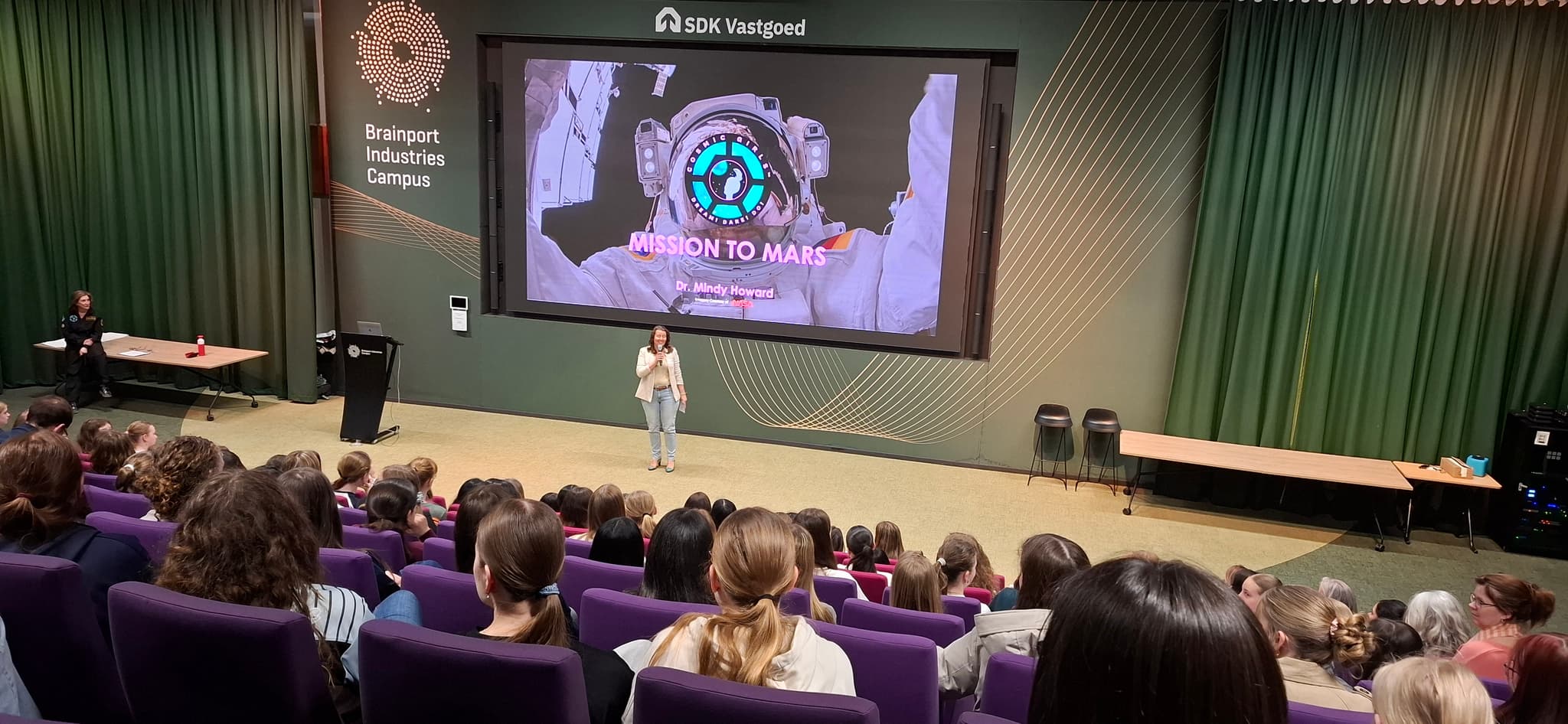
During the Mission to Mars workshop, organized by Cosmic Girls, the participants were challenged to think even bigger. Led by CEO Mindy Howard and development manager Angelique Kok, the girls worked in groups to solve the challenges of living on Mars—from shortages of food and oxygen to building materials and sandstorms. In doing so, they demonstrated not only knowledge, but also creativity. “Technology is not boring,” Howard explained. “The process of finding solutions is all about creativity.”
Howard also pointed out differences she has observed between boys and girls. “Boys tend to focus on the problem itself, whereas I think girls think more holistically and see the bigger picture.” In mixed groups, she noted, girls are often less heard. Events like this create a space where they can speak up and be listened to.
The power of role models
For many role models, the day was about more than just teaching skills. Iraldo emphasized the importance of connection and inspiration. “I want to be involved in the future,” she said. “Girls should be encouraged to pursue STEM careers, especially because it is challenging.” Her goal: “to create a feeling and excite them with my personality.” At the same time, she pointed to broader challenges, such as breaking down a male-dominated culture within STEM.
Monique Hagenouw, project leader at OOM, also emphasized the desire to make an impact. According to her, it starts simply: “Show that you are proud of your work and that you enjoy it.”
For Pleun van Otten, owner of the software company Cookie Crunch, the issue is personal. “Girls are not encouraged to study IT,” she said. As a young girl, she already knew she wanted to go into IT, but had limited opportunities. “There was an event I wanted to attend, but my school wouldn’t allow it. So my mother called in sick for me so I could go anyway.” Her message is clear: “When you help girls discover where they shine, they will naturally choose something they enjoy. It’s about feeling free and not being put in a box.”
“In a male-dominated world, women need role models to show that it is possible for them too,” Iraldo added. For her and the other role models, the day was about experiencing, discovering, and above all, building and creating together.
Breaking barriers in STEM
In her keynote, Howard spoke candidly about her own experiences. “They laughed at my dream… I felt like I had to make myself smaller.” Yet her message remained hopeful: “Big dreams grow slowly when you give them space,” and “big dreams are achieved together.”
Still, she acknowledged that change takes time. “A societal shift does not happen overnight,” she said, pointing to the lack of role models and structural barriers, especially for women of color. “Change starts with a seed, and that seed needs watering.”
A seed for the future
By the end of the day, that seed had clearly been planted. Some girls admitted they were shy at first, but many left feeling enthusiastic. “I liked it more than I thought I would,” said one student from Sondervick College.
Girls Day may not close the gender gap in STEM in a single day, but it offers something just as important: a beginning. As Dubling put it, “We hope that a career in technology, math, or science becomes a real option for these young girls.”