
How a turbine with a hole could make wind energy cheaper
Mega Windforce is working on an innovative wind turbine design that aims to make wind energy cheaper.
Published on October 26, 2026
© Mega Windforce

Mauro swapped Sardinia for Eindhoven and has been an IO+ editor for 3 years. As a GREEN+ expert, he covers the energy transition with data-driven stories.
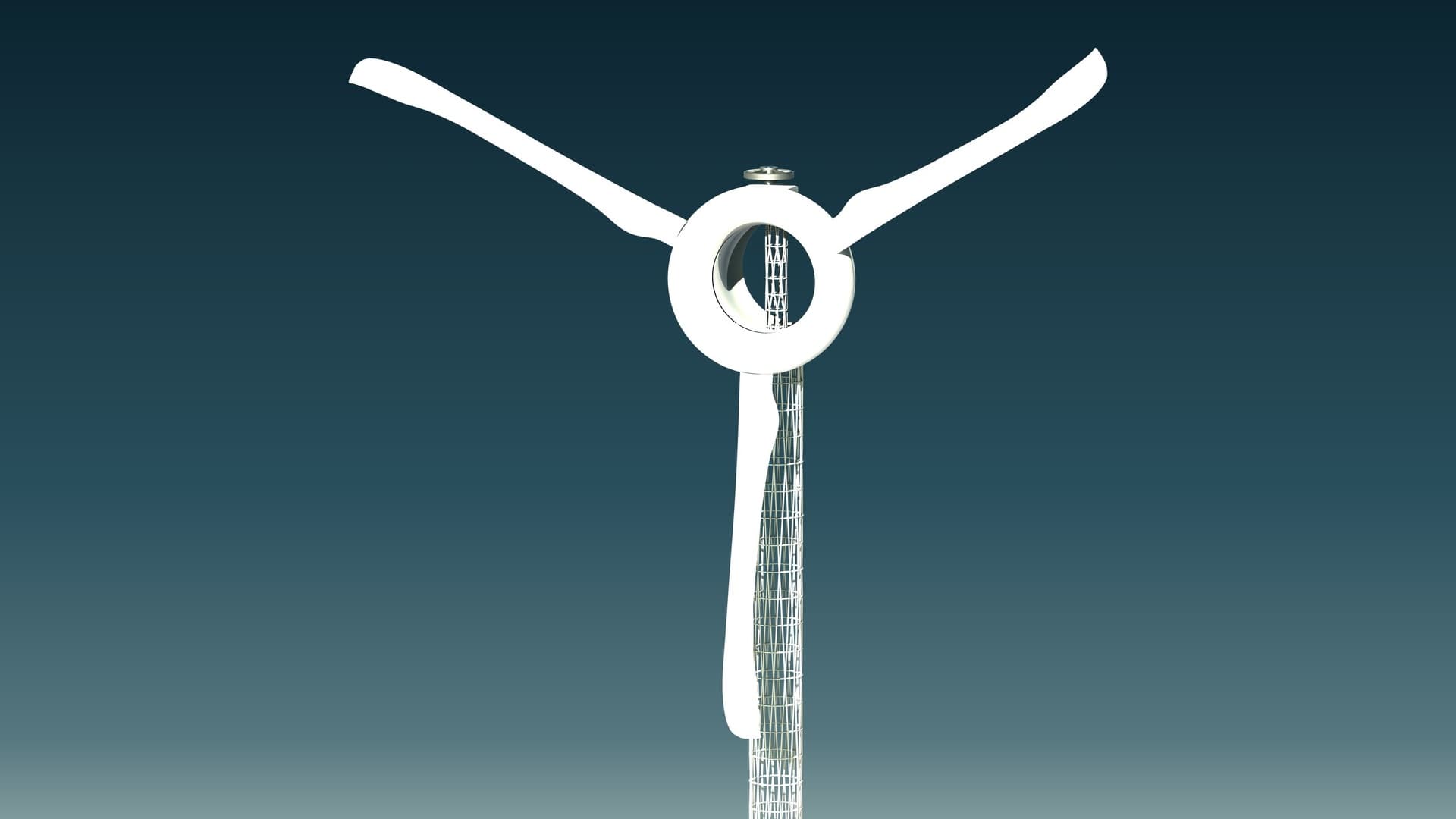
By now, we are familiar with wind turbines: tall, white, sturdy structures that are now part of the onshore and offshore landscape. A Dutch startup has built one with a hole in the middle, claiming it makes wind energy cheaper.
The concept came from a group of engineers at Delft University of Technology, who envisioned a turbine with blades attached to a ring rather than a bulky hub. After a turbulent start, new ownership relaunched Mega Windforce in 2020.
The company is currently raising €1.5 million in a crowdfunding round to bring its wind turbine concept to production: a 12- to 30-meter-tall tower with a 10-meter rotor diameter, capable of delivering 20-kW of electricity. Last year, the company built a proof of concept with a two-meter-diameter rotor, showing the technology works.
‘We simply made a hole in it’
In conventional wind turbines, the blades attach to a hub, and the generator sits in the nacelle, the capsule atop the tower. Mega Windforce’s WhisperRing is a direct-drive, meaning the rotor blades connect to the generator, ring design that carries the blades and lets magnets spin in a large circle.
“It is that simple: we made a hole in it. That avoids the turbulence and tower load of a large, solid nacelle which blocks a lot of wind,” says Reinoud Blom, COO of the company.
A patented magnetic transmission transfers torque to an external generator, a disk on top of the ring. “The large rotating ring drives a small shaft, and because the ring is so much bigger, even a slow rotation of the ring turns the shaft very fast. That fast rotation is exactly what a generator needs,” explains Blom.
The company says this makes maintenance easier, lets it use off-the-shelf generators, and reduces wear and energy loss because there is no friction at the magnetic transmission.
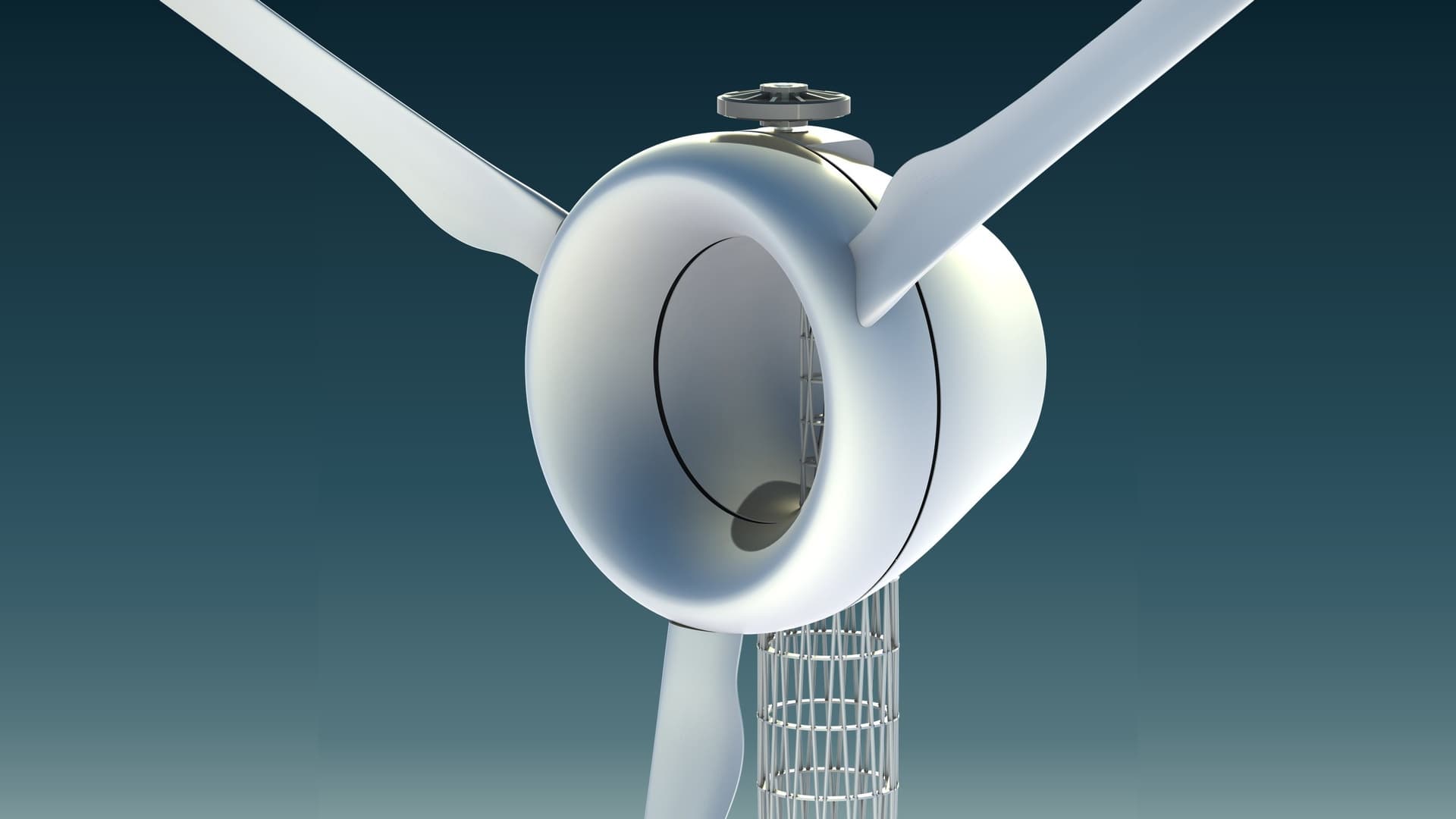
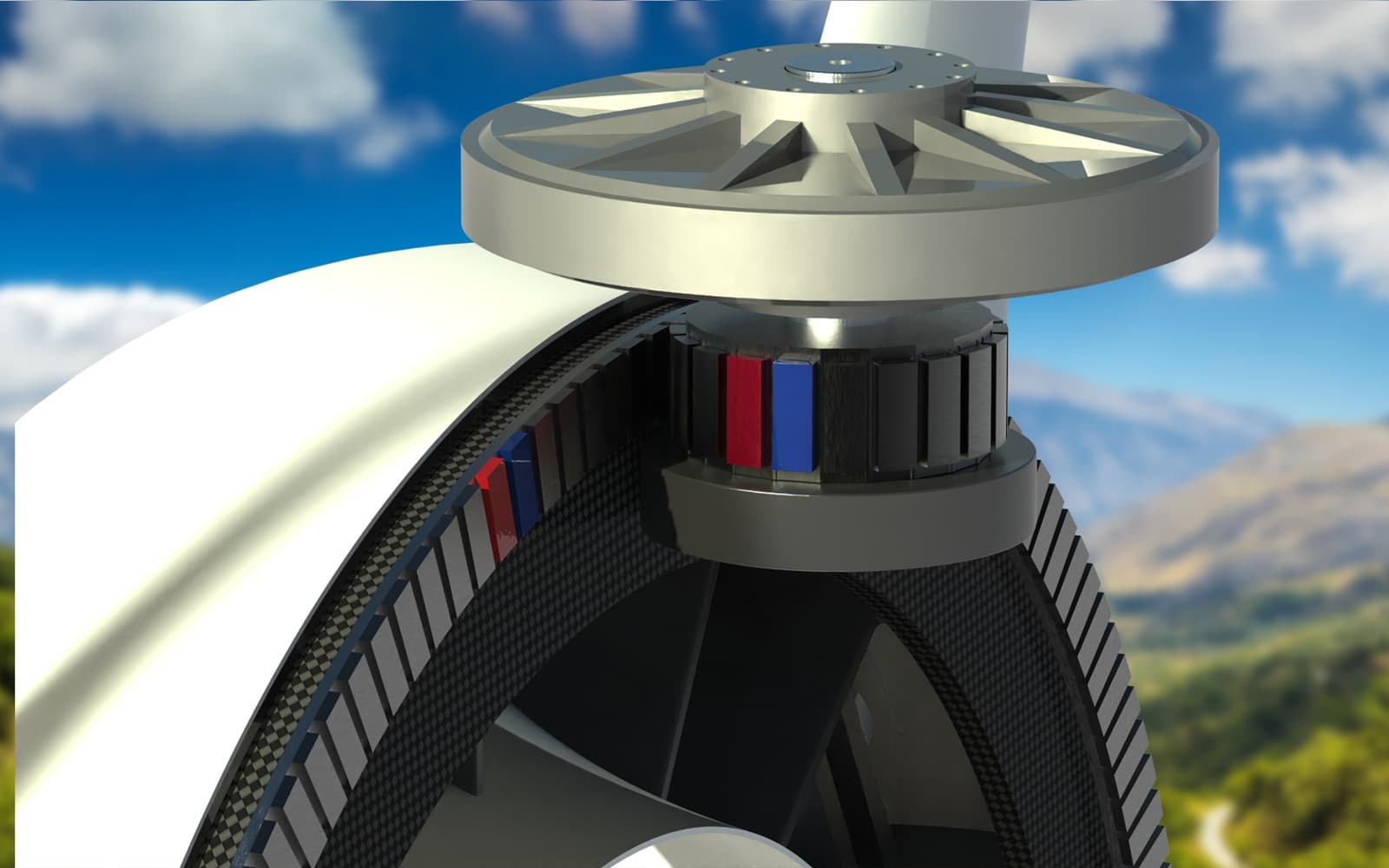
On the left, a close-up on the ring design and on the right, a zoom into the generator - © Mega Windforce
A design that helps maximize electricity production
The idea of making a hole in the turbine's core might seem counterintuitive. Yet, the center of the rotor is the least productive area. Conversely, the blade tips are the most productive part of the turbine because they move fastest, allowing the turbine to convert wind into electricity more efficiently.
Mega Windforce uses this knowledge to produce more energy in the same wind conditions. The ring is designed, similarly to an aircraft wing, to push part of the wind that passes through the middle towards the tips, compensating for the potential energy lost due to the hole.
“As a result, the power coefficient, the share of the wind's energy the rotor converts to electricity, is actually higher than for comparable turbines with the same swept area,” says Blom.
In addition, the ring and the lattice tower are made of CFRP, a carbon-fiber composite that is five times lighter than steel at a similar cost. This makes the turbine easier to install.
How does a wind turbine work?
Cheaper without getting bigger
For the WR20kW, the company estimates a levelized cost of energy (LCOE) of around €110 per megawatt-hour at a reference site near Schiphol Airport. LCOE is a metric used to assess and compare the average net present cost of electricity generation over an asset's lifetime. The company's calculations put comparable small turbines in the Netherlands above €200.
Down the line, the startup plans to unveil two larger models, a 500-kW turbine in 2029 and a 3 MW+ one in 2031. The former would serve energy hubs and onshore wind farms, while the latter would suit large-scale onshore and offshore wind farms.
Mega Windforce expects the next 500-kW model to reach €35 to €40 per megawatt-hour. Studies by the US National Renewable Energy Laboratory put recent onshore projects at €50 to €70, using a reference turbine 130 meters across. "You don't need huge turbines to achieve a low cost of energy," Blom says.
A fit for remote locations
This 20-kW model targets farms, business parks, and off-grid locations. Its first markets are Greece and Scotland. On many Greek islands, electricity comes mostly from diesel generators. A turbine helps save fuel. High energy prices in the Scottish market and a weak grid in remote areas make Mega Windforce’s turbine a good fit — especially given the abundance of wind. For these markets, the company plans to offer an LCOE of €70-90/MWh.
Alongside the crowdfunding – at the time of writing, over €1.2 million has been raised – Mega Windforce is moving ahead with deals. Last week, the startup signed an agreement with Turkish manufacturer Gimas and German company BaltiCo to explore developing a CFRP manufacturing plant.
Blom does not pretend it is a sure thing. “It’s high risk,” he says. Still, he points out that the turbine largely combines proven technologies, “a lot better than innovation plus innovation plus innovation.” The real test comes in the next few months, when the ten-meter prototype is finished.