
How Aerlijn plans to secure European airspace
Dutch startup Aerlijn leverages battle-hardened Ukrainian engineering to build cost-effective drone interceptors.
Published on March 10, 2026

Our DATA+ expert and Editor-in-Chief, Elcke Vels, explores AI, cyber security, and Dutch innovation. Her "What if..." column imagines bold scenarios beyond the norm.
The European air defense system faces its own set of challenges. Firing a multi-million-dollar missile to down a relatively cheap drone is a losing strategy, both financially and logistically. Yet, this is still happening in Europe. Aerlijn, an Amsterdam-based defense startup, offers a solution. The company designs and delivers fully integrated, affordable counter-UAS solutions, combining European engineering expertise with operational insights from Ukrainian battlefield experience. IO+ spoke with Aerlijn’s founder, Mykyta Aleksandrov.
The defining challenge of modern air defense is not just hitting the target, but doing so without bankrupting the defender. Traditional systems are designed for high-value targets, making them inefficient against the swarm tactics of modern adversaries. Aleksandrov is clear about his goal: “Our mission is to protect the nations of Europe cost-effectively. Russia is not only attacking Ukraine, but is increasingly active across European airspace, challenging stability and disrupting security conditions.”
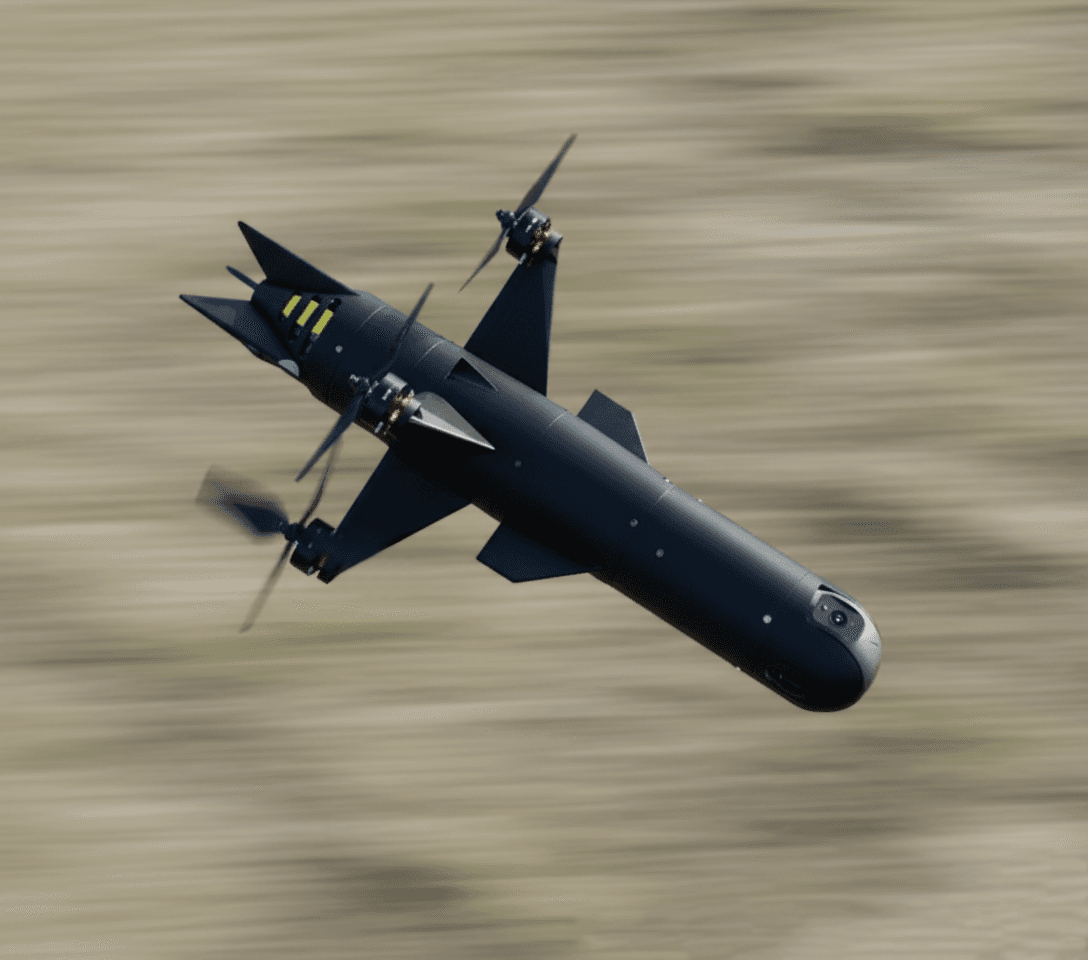
Aerlijn’s high-speed interceptor, the Nightmare V3, is now available for demonstrations in the EU. The drone has been tested with Aerlijn’s Ukrainian R&D partner ODIN Project. The interceptor counters Class-1 and Class-2 strike drones at speeds of roughly 280–300 km/h. It features a long-wave infrared (LWIR) thermal camera, automatic target tracking up to 800 metres, a tactical range of about 10 kilometres, and an operational ceiling above 6 kilometres.
The guidance system is semi-automatic, keeping a critical "human-in-the-loop", Aleksandrov explains. “An operator guides the interceptor toward the target’s pixel cluster, after which the system automates the terminal phase.”
Aerlijn reports successful interceptions
Ukrainian brigades have already deployed and endorsed the system, and now Aerlijn is expanding production capacity in Europe. The company has already reported successful interceptions of Shahed, Gerbera, and Lancet drones.
A dual-nation approach
The dual-nation approach addresses a common problem in defense innovation: bridging the gap between design and operational reality. "Ukraine provides operational, down-to-earth advice," Aleksandrov says. "The Netherlands can take this and make it mass-manufacturable and robust." This ensures the final product is not just a prototype but a scalable system ready for export.
A hypersonic system
Aleksandrov emphasizes that one solution does not fit all, which is why the company is working on several different types of systems. “Different threats require different products, each with its operational context and technical demands. The approach is to make targeted adjustments to existing systems: minimal engineering changes while boosting effectiveness in new scenarios.”
Technical developments: batteries
In the coming period, Aerlijn will focus on several technical developments, including advances in battery technology. The performance of an electric interceptor—range, speed, loiter time—is dictated by battery density. Aleksandrov notes Aerlijn is exploring new battery chemistries in Europe. “Shifting supply chains to Europe also reduces reliance on non-NATO suppliers.”
The near future
Important developments are on the horizon for Aerlijn. “In the near future,” Aleksandrov says, “our main focus is ensuring the system meets European regulatory and compliance standards. Development is one thing, but maturing the system to operational readiness across Europe is a real challenge.” EASA regulations demand rigorous safety assessments, and the founder estimates six months to a year for full European operational status, “compared with the rapid three-month deployment possible in Ukraine due to wartime urgency.”