
How Dunlop became famous with an invention that already existed
In a series of blog posts, Marco Coolen offers a glimpse into his work as a Dutch and European patent attorney at AOMB.
Published on August 23, 2026

Marco, a patent attorney at AOMB since 2013, shares his expertise on IO+ about patents—how they work, why they matter, and when they lose their value.
The most famous inventor of the pneumatic tire wasn’t actually the one who invented it. That sounds like a bad joke, but that’s exactly what happened.
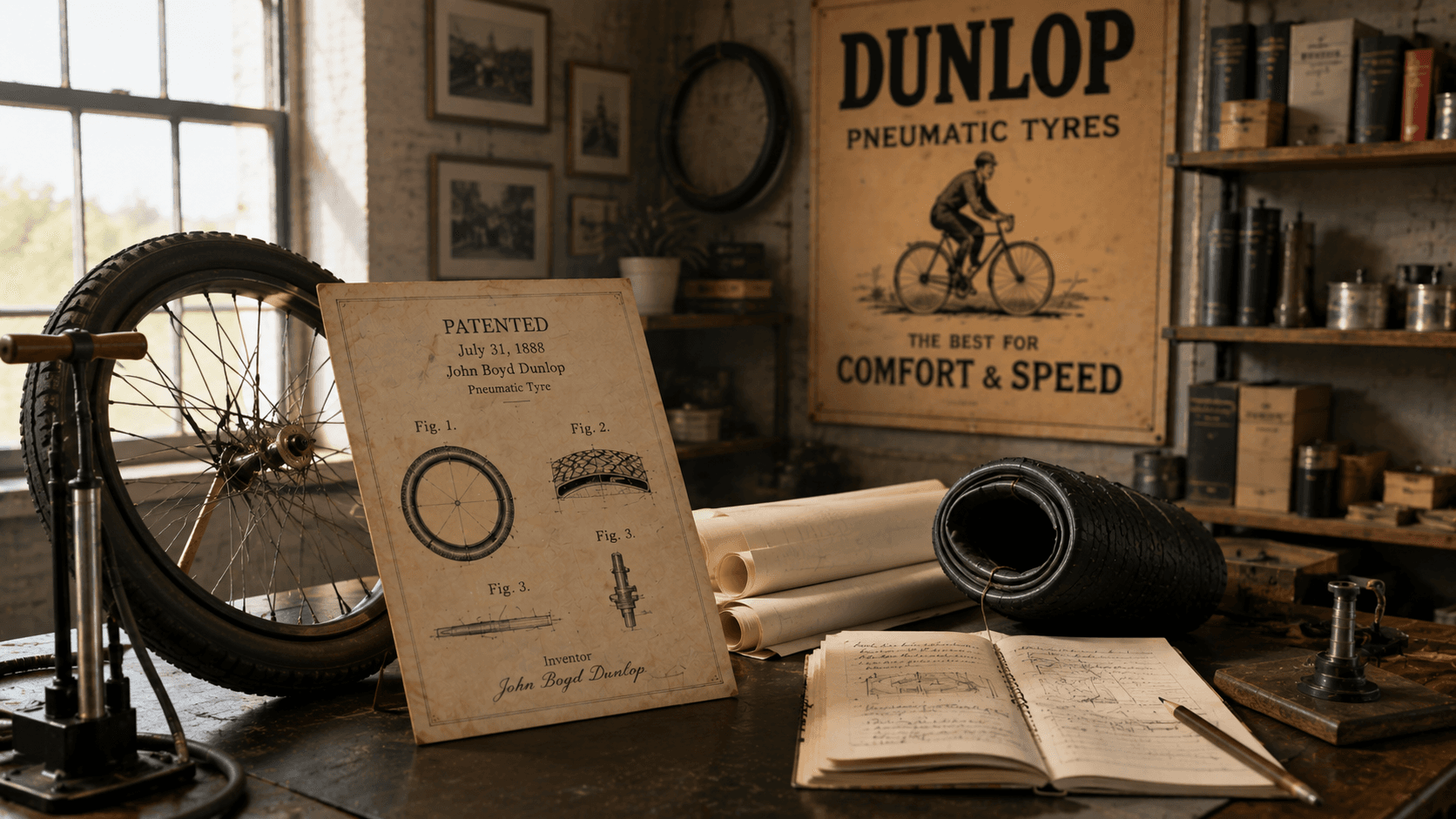
In 1888, John Boyd Dunlop was granted a patent for an air-filled tire. His invention turned out to be a huge success. Cyclists rode more comfortably, faster, and with less vibration. The burgeoning bicycle industry embraced the technology en masse, and the name Dunlop became a household name.
.png&w=2048&q=75)

End of story, you might think. But there was a remarkable twist. More than forty years earlier, another inventor, Robert William Thomson, had already been granted a patent on virtually the same concept. He, too, saw the advantages of an air-filled tire. He, too, had described and documented the technology.
So why did Dunlop end up getting a patent? The answer says a lot about how patents used to work.
Nowadays, a patent application is thoroughly examined. Researchers look at prior publications, existing patents, and other information that may be relevant to determining whether an invention is truly new. In the nineteenth century, things were different.
At the time, the British Patent Office did not conduct a substantive novelty search. An application was handled largely as an administrative matter. If the paperwork was in order, the patent was granted. No one systematically checked whether someone else might have already come up with the same idea.
As a result, Dunlop was granted a patent on a concept that actually already existed. Dunlop himself had not researched earlier patents either. He was convinced he had developed something new and saw no reason to look further back in history.
It wasn’t until later that everything changed. When Thomson’s old patent came to light again through a publication in a trade journal, it became clear that the pneumatic tire was not new at all. As a result, Dunlop’s patent protection was significantly weakened.
The technology remained successful. The market continued to grow. But the patent itself turned out to be worth far less than initially thought.
That story contains a lesson that remains relevant today. Many entrepreneurs fall in love with their solution. They see a problem, come up with a clever approach, and enthusiastically get to work. They then invest in development, prototypes, testing, and sometimes even a patent application.
Only then do they ask themselves the question that should actually have come first: Does this perhaps already exist? A thorough novelty search can sometimes feel like a tedious step that takes time. But in reality, it is often the cheapest investment in the entire innovation process. You discover what competitors are working on. You see which solutions already exist. And you avoid investing months or years in something that, from a legal standpoint, turns out not to be new ground.
Dunlop’s history shows that even successful entrepreneurs can make the same mistake. So before you develop, before you invest, and before you file for a patent: first check what’s already out there. Otherwise, there’s a chance you’ll reinvent the wheel. Or, in this case, the tire.

The World of Patents
With the help of Dutch and European patent attorney Marco Coolen (AOMB), we can better understand the world of patents. How do they work, why are they important, and when do they lose their usefulness?