
How Europe keeps its fuel reserves safe
From inspection robots to AI leak detection: this and more was discussed during StocExpo 2026 in Rotterdam.
Published on March 15, 2026
Masterstudente journalistiek aan de RUG, stagiair bij IO+, schrijft graag over de integratie van AI in het dagelijks leven
Each year, thousands of energy professionals gather in Rotterdam for one of the industry’s most influential events: StocExpo. The international conference, held in Ahoy, is dedicated to tank storage and the future of the fuel industry. In addition to many technological innovations, the event also focused extensively on the impact of the geopolitical situation in the Middle East on fuel storage. IO+ attended the event on 10 March 2026.
From crude oil and chemicals to new energy carriers such as hydrogen and ammonia: everything must be transported safely and efficiently. But how do you do that? For more than twenty years, StocExpo has been a central meeting place for companies and experts involved in the storage and transport of bulk liquids.
A strategic location
The choice of Rotterdam as host city is no coincidence. The Port of Rotterdam is one of the world’s most important energy logistics hubs, with hundreds of storage tanks lining its industrial landscape. These facilities store and distribute fuels, chemicals, and gasses that power economies across Europe and beyond. Against this backdrop, StockExpo brings together innovators.
Our day at the StocExpo
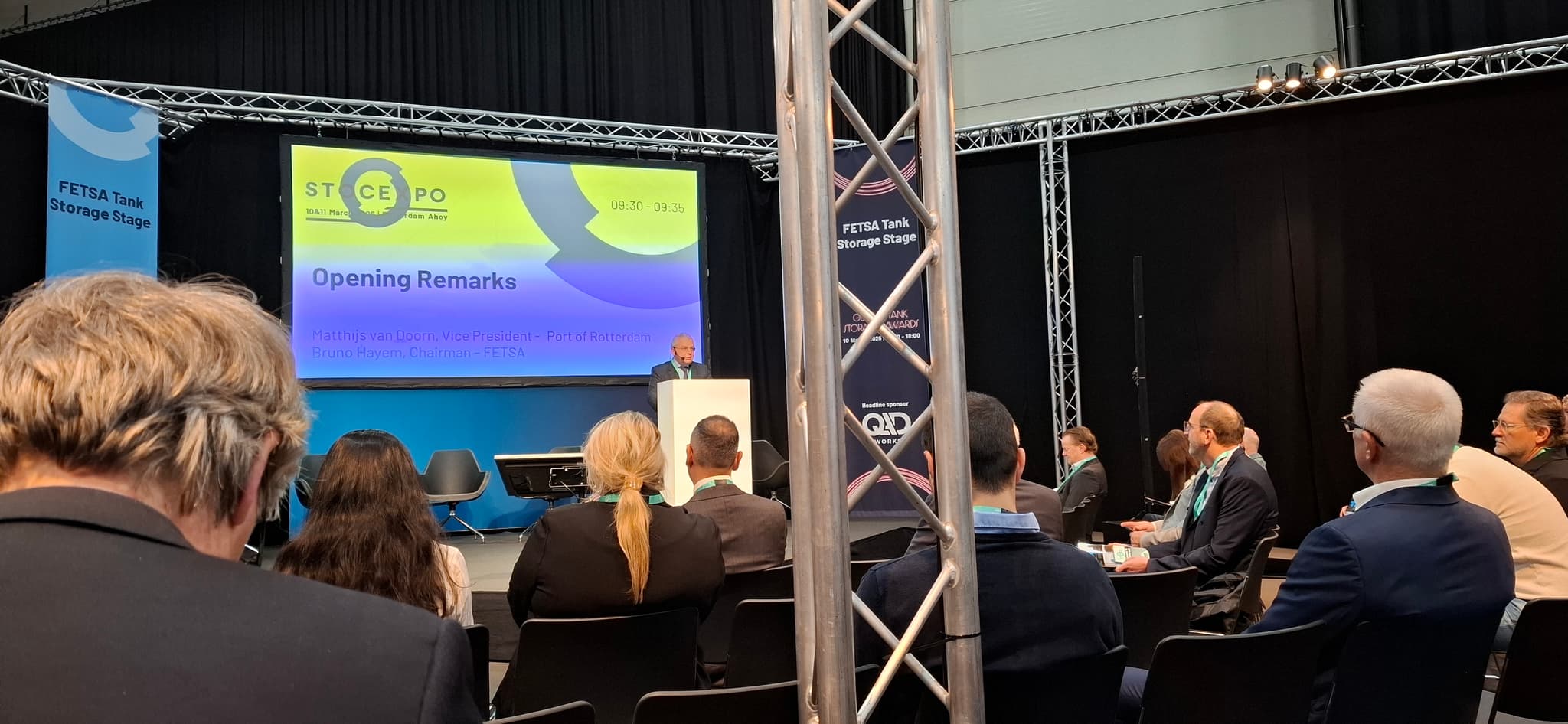
The FETSA (Federation of European Tank Storage Associations) tank storage conference was the first stop. Here, industry leaders, policymakers and terminal operators discussed the strategic role of tank storage in Europe’s energy system. The topics included energy security amidst the conflicts happening in the Middle East and between the Ukraine and Russia.
Energex, a London-based specialist commercial advisory practice that serves the energy sector, presented figures and graphs on the effects of the war in the Middle East on the fuel reserves and market prices in Europe. Discussions also focused on what the sector should focus on if fuel-powered machines are to remain operational in the future.
Presented by Energex partners Jason Rajah and Jonathan Martland, the realities of the current situation with the ongoing wars were made clear. “60% of jet fuel [in the EU] comes from the Middle East," says Martland. According to Rajah, if ships are no longer able to pass through the Strait of Hormuz, the EU has a kerosene reserve of approximately 26 days. India could be an alternative supplier, but it takes a tanker six days to get there.
“For 30 years, there have been fears of war in the Middle East,” says Martland. If the conflicts continue, supplies will quickly dwindle and prices will rise. Countries will compete with each other for available cargo, while ships will likely sail to the highest bidder – most likely being Asian markets, according to Martland.
The rise in oil prices has caused “a panic in the market," according to Martland. Rajah presents a graph that shows the rise in oil prices. While Covid-19-esque prices have not yet been reached, we are on the way to returning to that reality, Rajah explains. The Netherlands and other European countries have closed various refineries which make them dependent on the import of oil. Taken together, this is a good example of an energy trilemma. More emission production from import means that countries will buy less so as to add as little to the carbon emitted as possible. This weakens the security of supply which in turn raises prices. This trilemma can be seen from various starting points.
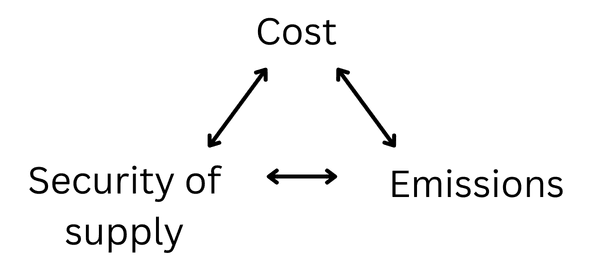
Energy trilemma © Amber van Kempen
Responses to deindustrialization and a multipolar world
Next on the agenda was a panel with market intelligence companies and tank storage holders. “In-ground tanks are real estate, they are static and cannot be moved,” says Ramon Ernst, integration leader at Curoil, a regional supplier of fuel products and services in Curacao and Bonaire. With tanks not in use or not receiving fuel due to wars or conflicts other ways of using them must be exploited.
Patrick Kulsen, CEO of market research and consultancy firm Insights Global voices the thoughts that go through tank holders’ heads when such a time arrives: “What are the options? Can we cater to other flows? Are there alternative uses or products? Can tanks be converted into batteries”. After all, companies want to continue generating revenue and make optimal use of their infrastructure.
To the floor
After the panel discussion IO+ wandered around the event hall to get a general idea of what is most important to the exhibitioners. There was a strong focus on technologies designed to improve the safety, maintenance and inspection of large storage tanks.
A significant number of companies such as Square Robot and Eddyfi Technologies showcased new (semi) autonomous robotic inspection systems capable of monitoring the structural health of tanks from the inside. These robots are designed to detect corrosion, thinning, or cracks on tank floors and walls. By combining sensors with advanced data analysis, these systems aim to identify potential problems earlier and reduce the need for lengthy shutdowns.
PFAS-free foam for oil and chemical fires
Fire safety was another prominent theme on the exhibition floor. Several companies demonstrated new firefighting solutions, including next-generation foam designed to extinguish oil and chemical fires without the use of PFAS, a group of persistent chemicals that have raised environmental concerns in recent years. With stricter regulations emerging worldwide, PFAS-free firefighting technologies are increasingly important for industrial facilities such as tank terminals and refineries.
Companies like BioEx and Saval BV also presented foam as a fire extinguishing medium.
The firefighting robot
A company that could work with these new foam extinguishers is Angatec. This company, based in France, has created a remote control robot with various attachments. For example, a hose attachment, a stretcher, a ventilator, or supplies for the firefighters.
According to firefighting specialist Francois Cheverry, the robot is primarily intended to protect firefighters. ‘It can easily enter dangerous areas, such as tunnels, without losing contact with the fire brigade outside due to the thick walls. This is thanks to military-grade antennas.’
The fan module can be used in smoke-filled buildings, for example. "The smoke can be so thick that even with all protective equipment, nothing is visible. With the fan, the smoke can be blown away within seconds, allowing firefighters to do their job again,” says Cheverry.
Smart sensors for environmental protection
Leak detection was also widely represented, for example by Goltens Rotterdam BV. Exhibitors presented a range of solutions that combine sensors, robotics, and AI-powered analytics to identify even small leaks in tanks, pipelines and surrounding infrastructure. These technologies aim to improve environmental protection while helping operators respond quicker to potential incidents.
Suspended platforms for complex worksites
Among the technical innovations was a modular building platform and better ropes developed by Dutch company Sky-Access. The platform, which is an American creation, is designed to support loads of up to 400kg per square meter and can be suspended from existing structures.
Technical director Marin van Oorschot: “This makes it possible to carry out construction or maintenance work above active infrastructure - such as bridges or industrial installations - while allowing activities underneath to continue uninterrupted.”
The reduction of scaffolding installation time in hard to reach places enables workers to enter and exit a tank quicker for example and saves the client money. “The fact that it can carry more weight than traditional scaffolding and that it can be installed almost anywhere is a great benefits,” says Van Oorschot.