
LeCun, ElevenLabs, DeepL urge EU to put AI in the next budget
A group of European founders and scientists sent an open letter to the European Commission calling for a dedicated budget for AI.
Published on November 19, 2026

Team IO+ selects and features the most important news stories on innovation and technology, carefully curated by our editors.
Some of Europe's best-known AI entrepreneurs and researchers have called on EU leaders to set aside a dedicated, large-scale budget for artificial intelligence in the bloc's 2028–2034 long-term budget, warning that whatever is not secured in the current negotiations will not exist before 2035.
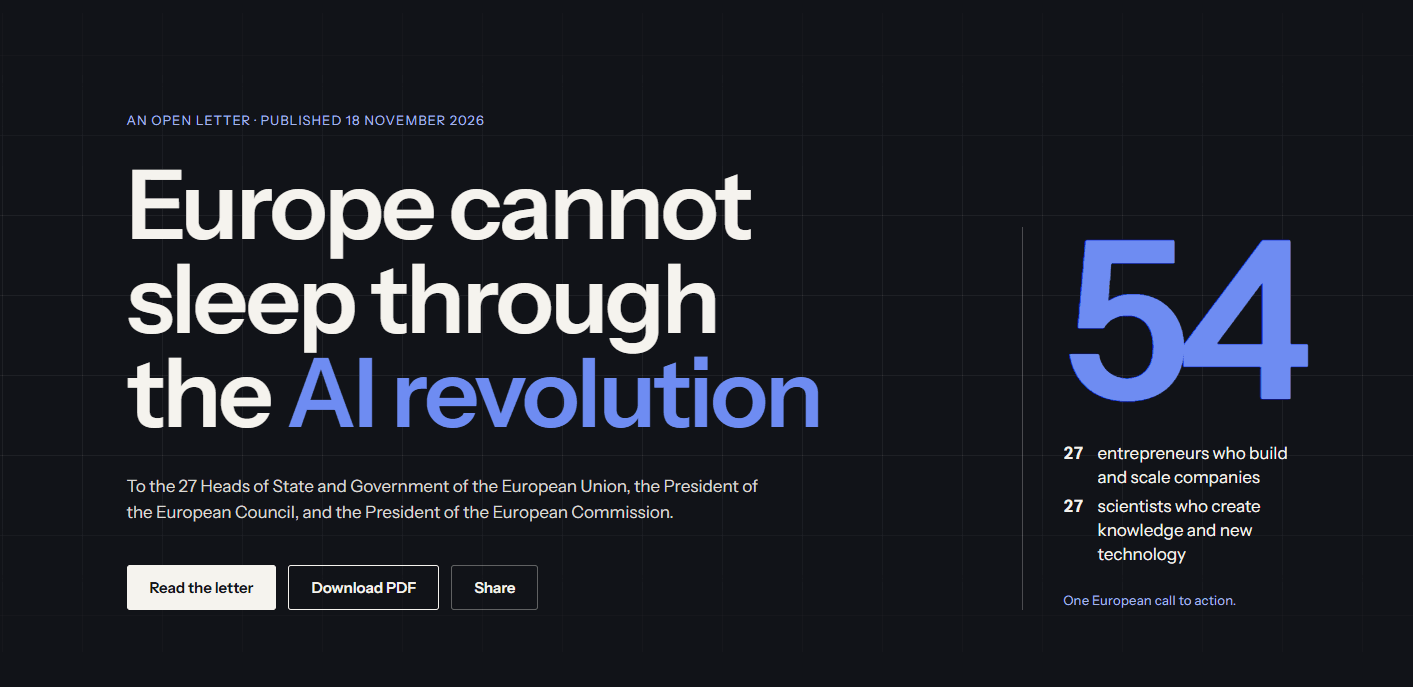
The open letter, titled "An Urgent Call: Europe Cannot Sleep Through the AI Revolution", was released on Wednesday and is signed by 59 entrepreneurs and scientists from all 27 member states. It is addressed to the EU's heads of state and government and to the presidents of the European Council and the European Commission.
The signatories include the chief executives of ElevenLabs, Lovable and DeepL, OVHcloud founder Octave Klaba and InPost's Rafał Brzoska. Scientists on the list include Turing Award winner Yann LeCun, Nobel-winning economist Philippe Aghion, Bernhard Schölkopf and Sepp Hochreiter.
The group presents itself as The54, an informal, non-partisan collective rather than an organisation. Its website says the initiative began as a grassroots effort, that signatories were invited personally for their record in building European tech companies or in AI research, and that the list is closed to new names.
A widening gap
The letter's central argument is that Europe is competing with a fraction of the capital, computing power and scaling capacity of the United States and China, and that the gap is growing. It notes that American companies alone are spending hundreds of billions of dollars on AI infrastructure this year, while the EU has committed tens of billions of euros to its AI Gigafactories programme.
"We cannot win a heavyweight fight with featherweight budgets," the letter states.
Five demands
The signatories set out five priorities:
- Simplification: building on the Commission's first Digital Omnibus with binding cuts to red tape, and creating a "28th regime" that would let companies incorporate once and follow a single set of rules across the EU, along with harmonised treatment of employee stock options.
- Scale: keeping start-ups from moving to the US for later-stage funding by steering pension and insurance savings into European scale-up funds, completing the single market for capital, having governments act as anchor customers and widening access to data.
- Investment: a dedicated, ambitious AI allocation within the proposed European Competitiveness Fund and the next research framework programme, designed to draw in a multiple of private money. Until then, current EU IT budgets should favour European AI providers.
- Talent: independent, science-led flagship AI institutes, jointly funded by the EU and member states and modelled on the ELLIS Institutes.
- Strategy: a standing AI competitiveness agenda with published targets for investment, compute, talent and adoption, reviewed by leaders every year.
No price tag
The letter does not name a figure, but it asks for funding on a scale that would be noticed in Washington and Beijing. Several of the asks echo proposals made in October by former Italian minister Vittorio Colao, who also called for a 28th regime and more computing capacity.
The appeal lands as member states and the European Parliament negotiate the EU's next multiannual financial framework, the seven-year budget that sets spending priorities from 2028. With talks under way, the signatories argue that the coming months will decide whether Europe can field globally competitive AI companies in the next decade.