
New ideas, big ambitions: startups pitch their businesses
From AI to psychological care: entrepreneurs pitch their innovations at Demos Pitches & Drinks in Tilburg.
Published on November 19, 2026
On 16 November, entrepreneurs, students, investors and other interested visitors gathered at the LocHal in Tilburg for a new edition of Demos Pitches & Drinks. With a beer or glass of wine in hand, several startups had three minutes to pitch their ideas. An open mic session followed, with last-minute participants having one minute to introduce their company, product, or request for support. The pitch topics ranged from artificial intelligence and mental healthcare to industrial sustainability and circular materials. What the pitches had in common was a search for people who could help take these ideas further: from potential customers and investors to technical partners and experts.
Making business processes easier to understand
Many organisations use different systems to document their business processes. Documents are stored in Word, calculations in Excel and work instructions in other applications. According to Steven Oosterbeek, co-founder of Makisto, this makes it difficult to maintain an overview. “Four tools, nothing is connected,” he says, summing up the problem. This also becomes an issue when companies want to use AI in processes that have not been fully mapped out.
Makisto is developing a platform that allows companies to describe and connect their processes in a standardised way. Documents can also be linked to the relevant process steps, bringing all the information together in one place.
The company launched its solution on 1 September and is looking for students to test the platform. The team wants to find out how new users work with it and where improvements can be made.
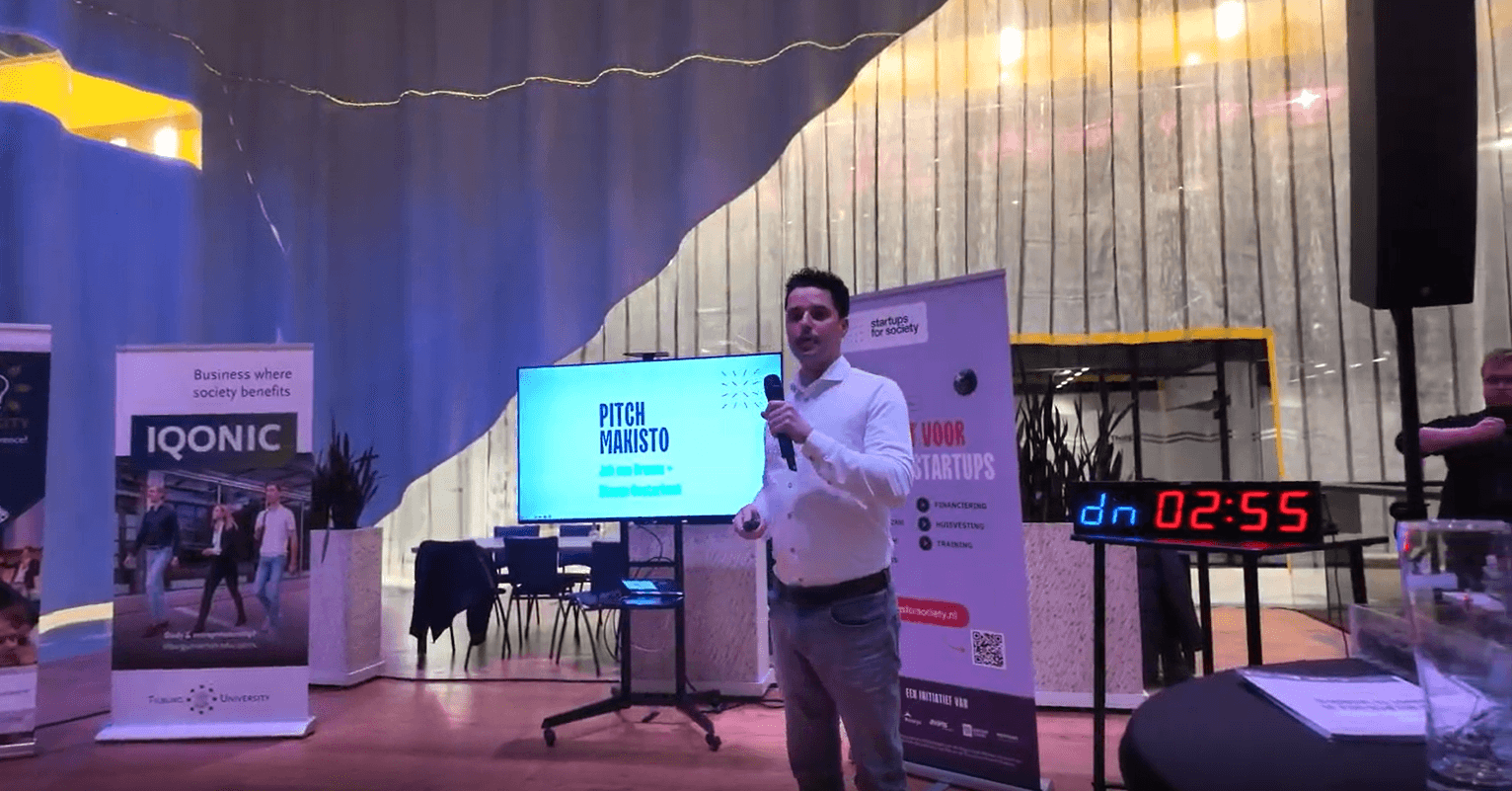
Steven Oosterbeek
A diary for people waiting for psychological care
People waiting for psychological care continue to deal with stress, uncertainty and emotional challenges in the meantime. With Journally, Elias Eichler wants to use this waiting period by offering a digital diary where people can record their thoughts, feelings, and experiences. The ultimate goal is to create a personal document that patients can share with their psychotherapist at their first appointment.
Users can write entries, record audio or upload photos of handwritten documents. A combination of AI models asks questions to help them reflect more deeply. Over the waiting period, this creates an overview that the healthcare professional can use to better understand the patient's situation more quickly.
Journally has developed an initial product and is working on a proposal for a clinical study. The next step is to investigate whether the application can genuinely help patients and therapists.
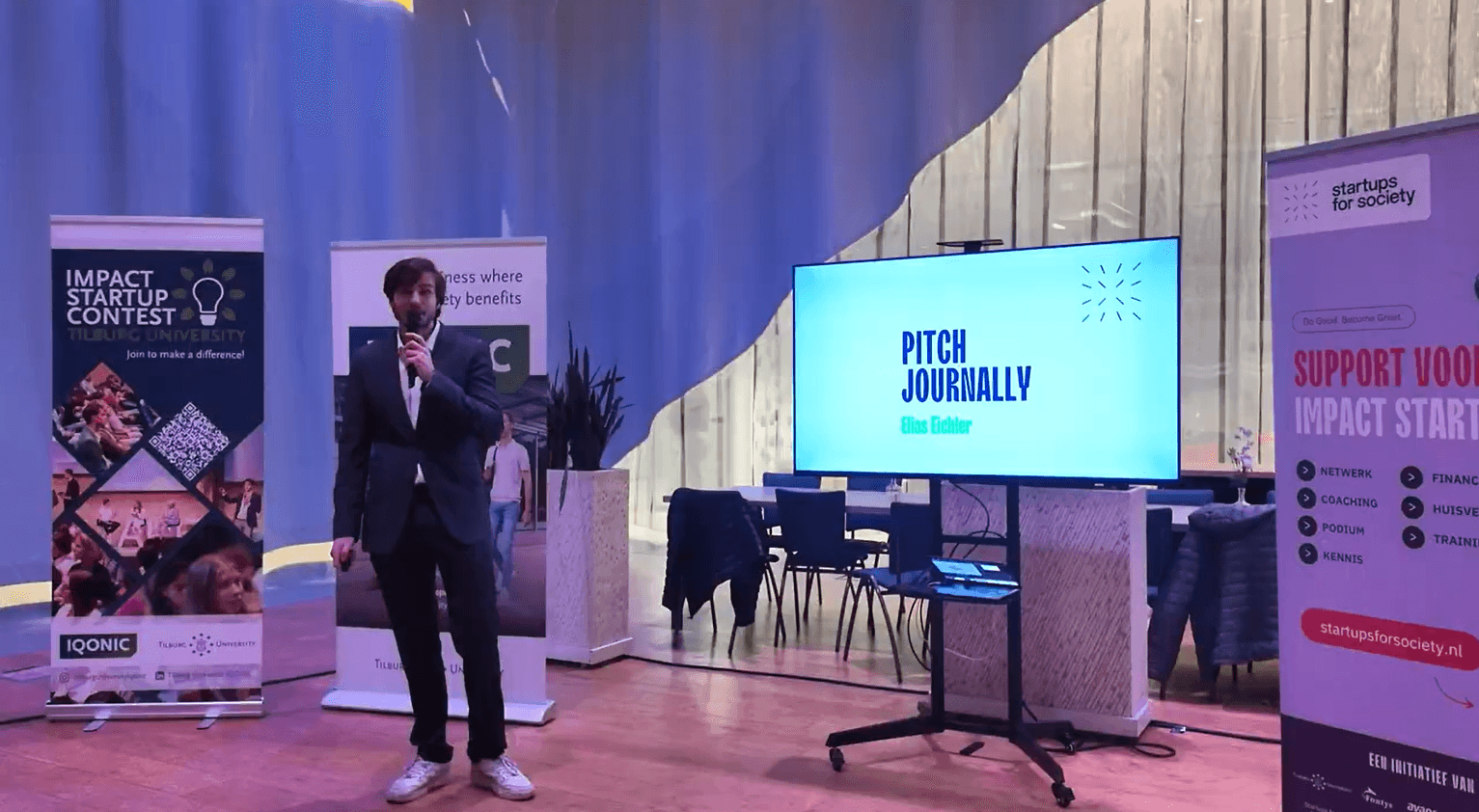
Elias Eichler
Using AI with people in mind
Not every organisation benefits from using as much AI as possible. That was the message from Simone Salazzo, founder of Human Susy. Through his consultancy, he helps small and medium-sized enterprises determine where artificial intelligence can genuinely add value. “We don't need to waste resources,” he says.
According to Salazzo, more than 80 per cent of companies with AI projects fail to achieve a positive return. AI can also affect employees' trust, skills and motivation. He therefore advocates a more people-centred approach.
Human Susy offers training in AI awareness and critical thinking, maps business processes and guides organisations through implementation. Salazzo is looking for potential clients and contacts who can connect him with interested organisations.
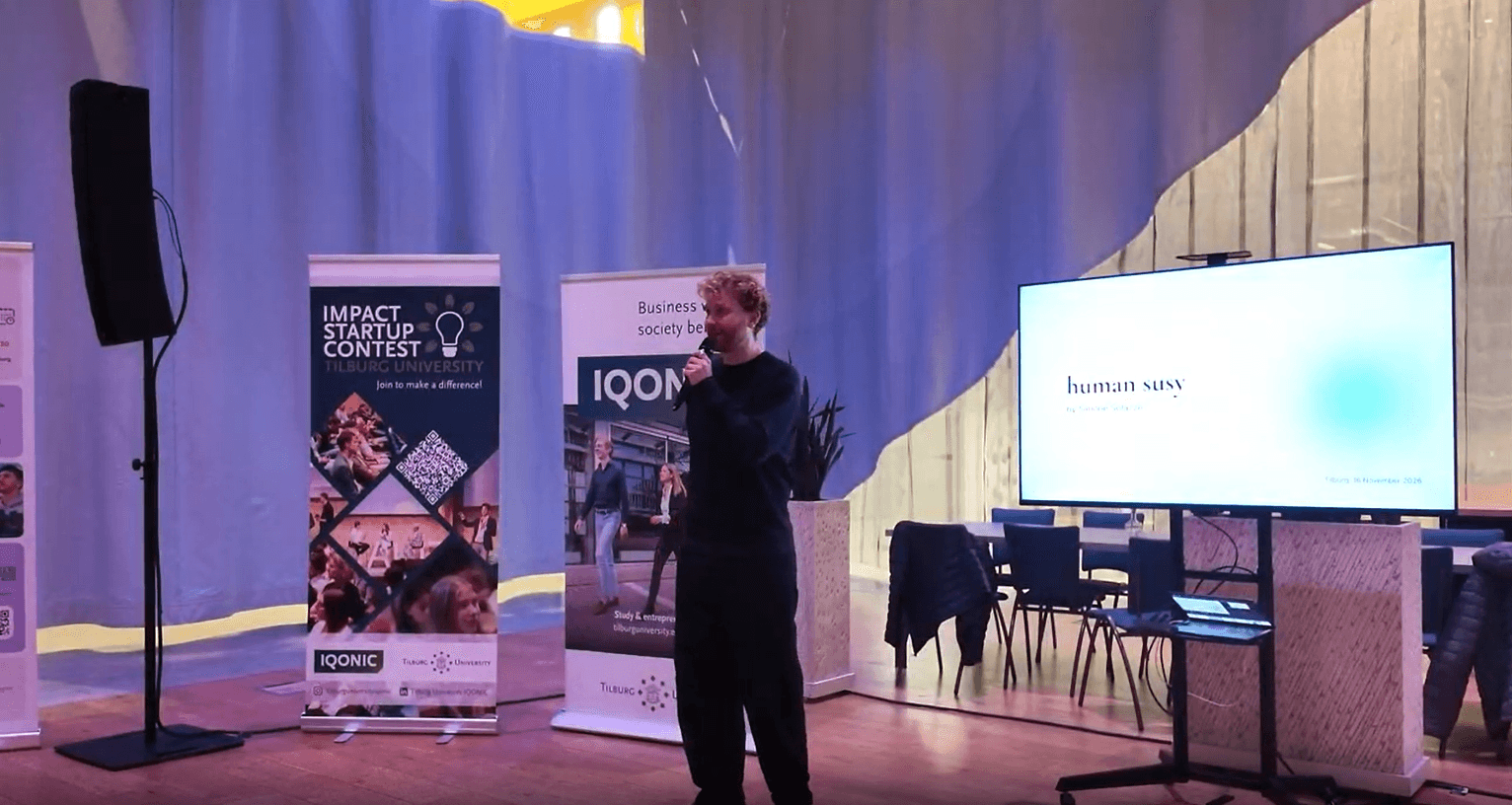
Simone Salazzo
Storing industrial heat in sand
Industry uses large amounts of high-temperature heat, which can be difficult to make more sustainable. Dennis Heijkoop, initiator of Sandr, pointed out that around 40 per cent of heat consumption in the Netherlands comes from industry. “80 per cent of that heat is high-temperature heat,” he explains.
Sandr is developing a thermal battery that stores heat in sand. Using liquefied gases and a soda-based material, the sand is heated to around 700 degrees Celsius. The stored heat can later be used in industrial production processes, such as brick manufacturing. According to Heijkoop, the battery is approximately ten times smaller than conventional batteries.
For the next stage of development, Sandr is looking for industrial companies willing to test the technology. “We want to start by testing locally and then expand further,” Heijkoop says.
Dennis Heijkoop
Turning industrial air pollution into usable soil material
Shreeyaa Senthilnathan presented Airloop, a project that aims to tackle industrial air pollution using AI. According to her, existing technologies such as biofiltration and adsorption have drawbacks: filters can end up in landfills and are not always suitable for highly concentrated gases. Real-time monitoring of the treatment process is also lacking.
Airloop proposes a process that converts polluting gases into solid substances at high temperatures. Microorganisms would then break these substances down into material suitable for use in soil. AI and sensors would monitor and analyse the process. The results would be made available to companies and government agencies through a website.
Senthilnathan developed the idea during her bachelor's degree and submitted it to the Indian patent office. There is no working prototype yet. “We are looking for funding,” she says.
Shreeyaa Senthilnathan
Quick-fire innovation: the open mic
The pitches were followed by the open-mic segment. Participants had one minute to introduce themselves, their business or their request for support. This resulted in four different calls for support.
1. Investing in early-stage startups - Sam from Graduate Ventures spoke about investment opportunities for startups. The organisation, formerly known as Round 1 Ventures, focuses in part on companies in the pre-seed stage. In addition to funding, its network provides access to business expertise and contacts.
2. Support with intellectual property - Paul Simons works for the Netherlands Patent Office and supports startups, scale-ups and innovative small and medium-sized businesses in the southern Netherlands. His advice goes beyond patents and also covers intellectual property strategies, trademarks, trade secrets and attracting investors. The services are free of charge for startups and SMEs registered in the Netherlands.
3. Fish leather for sustainable fashion - Zoe Prifti, founder of Mermaid Skins, is developing fashion products made from fish leather. She is looking for technical expertise for her business, particularly a tailor who can help develop corsets made from this material.
4. Interior products made from recycled cardboard - Nigel van den Besselaar presented Duo Design. The company aims to give discarded cardboard a second life as a material for interior products. With the Duo Design World Tower, the team is working on a new application for cardboard and is looking for people willing to contribute ideas for further development and improvements to the production process.