
PIC Summit 2026: Europe’s chips need the right pressure to scale
“It’s now or never.” Peter Wennink and NXP's Lars Reger warn that Europe’s photonics and chips must scale fast or fall behind.
Published on November 4, 2026
Mauro swapped Sardinia for Eindhoven and has been an IO+ editor for 3 years. As a GREEN+ expert, he covers the energy transition with data-driven stories.
When Peter Wennink was CEO of ASML, a table full of engineers taught him a lesson that became his mantra: apply the right pressure, and everything comes through. "That has been a mantra for me during the rest of my career and my life," the former ASML chief told the audience of the PIC Summit in Eindhoven yesterday. "How do you create the right pressure?"
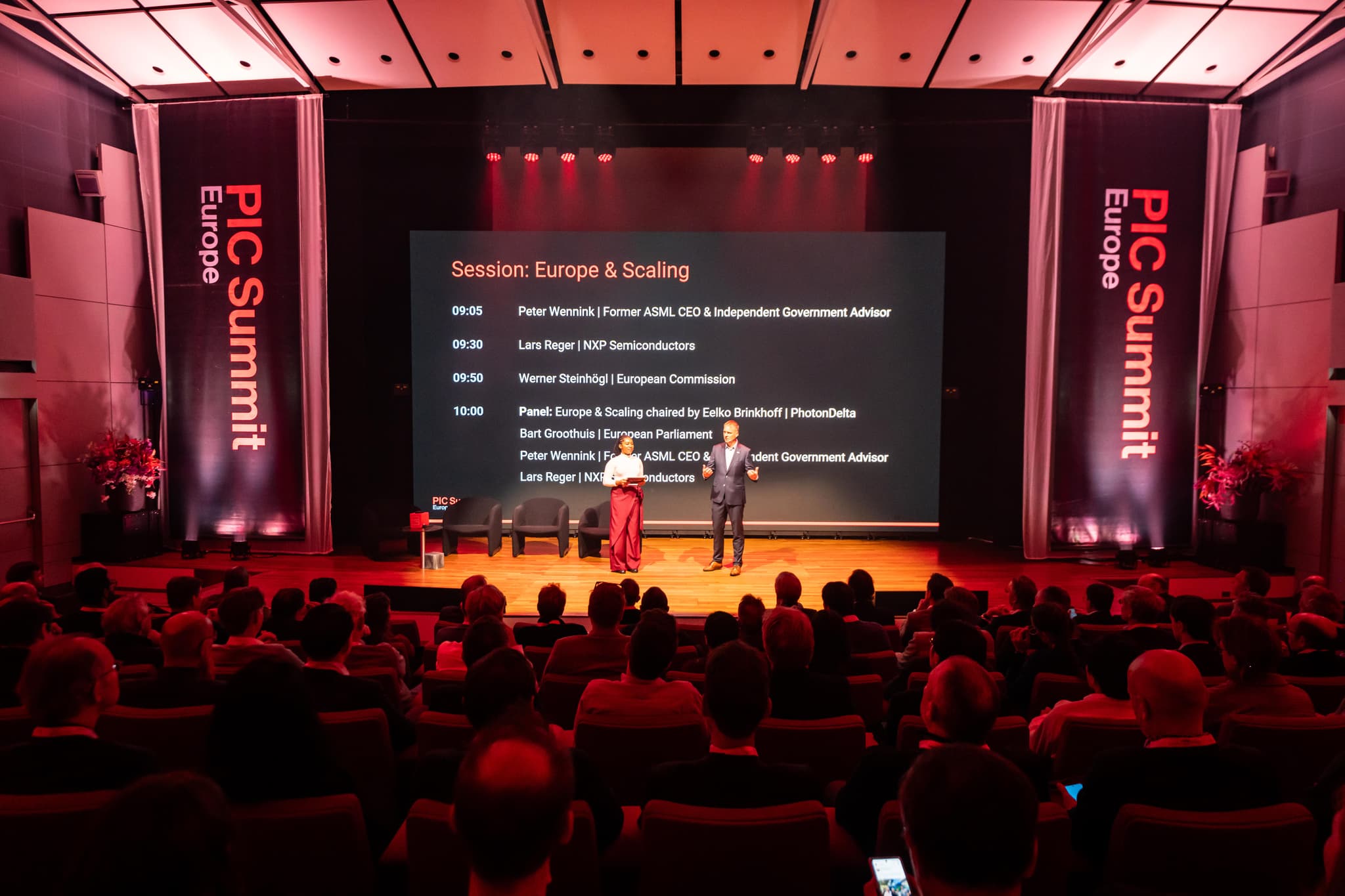
The PIC Summit is a two-day event on photonic chips organized by the nonprofit Photon Delta, focusing on integrated photonics. Held at Eindhoven’s Evoluon, the event reached its fifth edition this year and revolved around the theme of “Scaling integrated photonics for global impact,” bringing together companies, experts, and policymakers.
How to scale the potential that’s there? Europe, Wennink argued, has the creativity, the people, and the collaborative model. What is missing is urgency. "How do we create this pressure, so that this sense of urgency is actually paramount and things can happen now?" he asked. "We cannot wait. It's now or never."
Photonics is one domain where Europe can still have a say, home to influential players such as ASML, NXP, and Infineon. Photonic chips, also known as photonic integrated circuits (PICs), use light to transmit data, enabling faster, more efficient chips. They can process and transmit information faster than conventional electronic chips and can also be manufactured using established production processes.
Stuck at the pilot line
Alongside the former ASML’s CEO keynote, there was also space for talks by NXP’s CTO Lars Reger and the European Commission's head of the sector of the microelectronics and photonics industry, Werner Steinhögl. The same problem resurfaced: Europe excels at proofs of concept, but is not as good at turning them into volume.
Reger put the scaling problem in semiconductor terms. "For NXP, we have the slogan internally: the fun only starts if we can sell 500 million pieces of one chip," he said. "Let's make sure that we are not stuck on the pilot-line level, because that is my biggest fear at the moment in the European ecosystem. They are getting enough subsidies to have a pilot line, and they don't have the momentum to fire stage two of their rockets."
The EU’s stance
The European Commission broadly agrees. Over 85% of the Chips Act budget, a legislative package aimed at stimulating semiconductor production in the bloc, has been committed, and about €32 billion in production investment has begun. However, only 2 of the 20 projects receiving state aid are in photonics.
The Chips Act 2.0 aims to close this gap. A new instrument supports the stage between pilot line and fab, with photonics explicitly listed in its scope. Moreover, the first iteration granted state aid for a first-of-a-kind project, not for full manufacturing capacity. Taking input from the industry, that will now be possible.
"The pilot lines stop at a certain technology readiness level, and then you have to build the fab, but there is something in between," Steinhögl said. "Scaling is super important. This we understood in Brussels."
Running at photonic speed
In a following panel discussion, Wennink and Reger were joined by Bart Groothuis, a member of the EU parliament. The politician argued that Brussels’s role is shifting. "In the previous Chips Act we would subsidize your technology, maybe a pilot line," he said. "Now we set you up with data-centre owners. We finance the qualification process to make sure that you're in the market. We help you with standardization, and in permitting."
The Commission has proposed a 12-month permitting deadline for new fabs; Groothuis wants six. "We measure the progress not in billions, not in the number of fabs," he said. "I measure the success of the Chips Act at speed."
Wennink pointed to where speed actually breaks down. A proposed AI gigafactory in Rotterdam has port land, North Sea wind power the grid cannot absorb, and an anchor customer for a third of its capacity, yet it is stuck on permits. "The problem in society these days is we have democratized the decision-making to the lowest level," he said. "On the major issues, it needs to be centrally led." His fix: binding agreements with national governments on digital and energy.
Groothuis added that the bottleneck is no longer only supply. "The global trend in politics is not supply politics, it's demand politics, and Europe is the last in line," he said, recounting talks with Asian lawmakers. "We are very good at financing innovations, but we need to be good at finding our first customers."
Applying the right pressure
So who applies the pressure? Wennink's answer starts with rules: state aid that backs start-ups and scale-ups, competition law that lets European champions combine, and wider guardrails for finance. "We do take risk, but we're not informed. We don't understand risk," he said of Europe's pension funds and banks. "Risk is good, and risk should be supported and not blocked."
But his deeper point was about society. "Politicians are still in their own trenches, looking at each other and shooting arrows at each other. It's like World War I, and nothing moves," he said. "But in the end, politics is not an alien life form. Politics is us. We determine who should lead."
Reger turned the pressure back on industry. When Ukrainian contacts asked whether NXP's automotive radar chips could detect drones, his engineers wanted six months to qualify a new chip. "I said, stop! There is a chance to have either nothing in Ukraine or a system that is overheating, and you need to put a cooling fan there," he recalled. "We cannot wait for politics, and we cannot point to others to do our jobs."
The speakers converged on relevance rather than autonomy. "We should focus on indispensability," Groothuis said. "If you don't sit at the table, you're probably on the menu."