
QuiX Quantum delivers Carina, the first Dutch quantum computer
Enschede's QuiX Quantum becomes the first Dutch firm to deliver a complete quantum computer, built on photons instead of frozen qubits.
Published on July 15, 2026
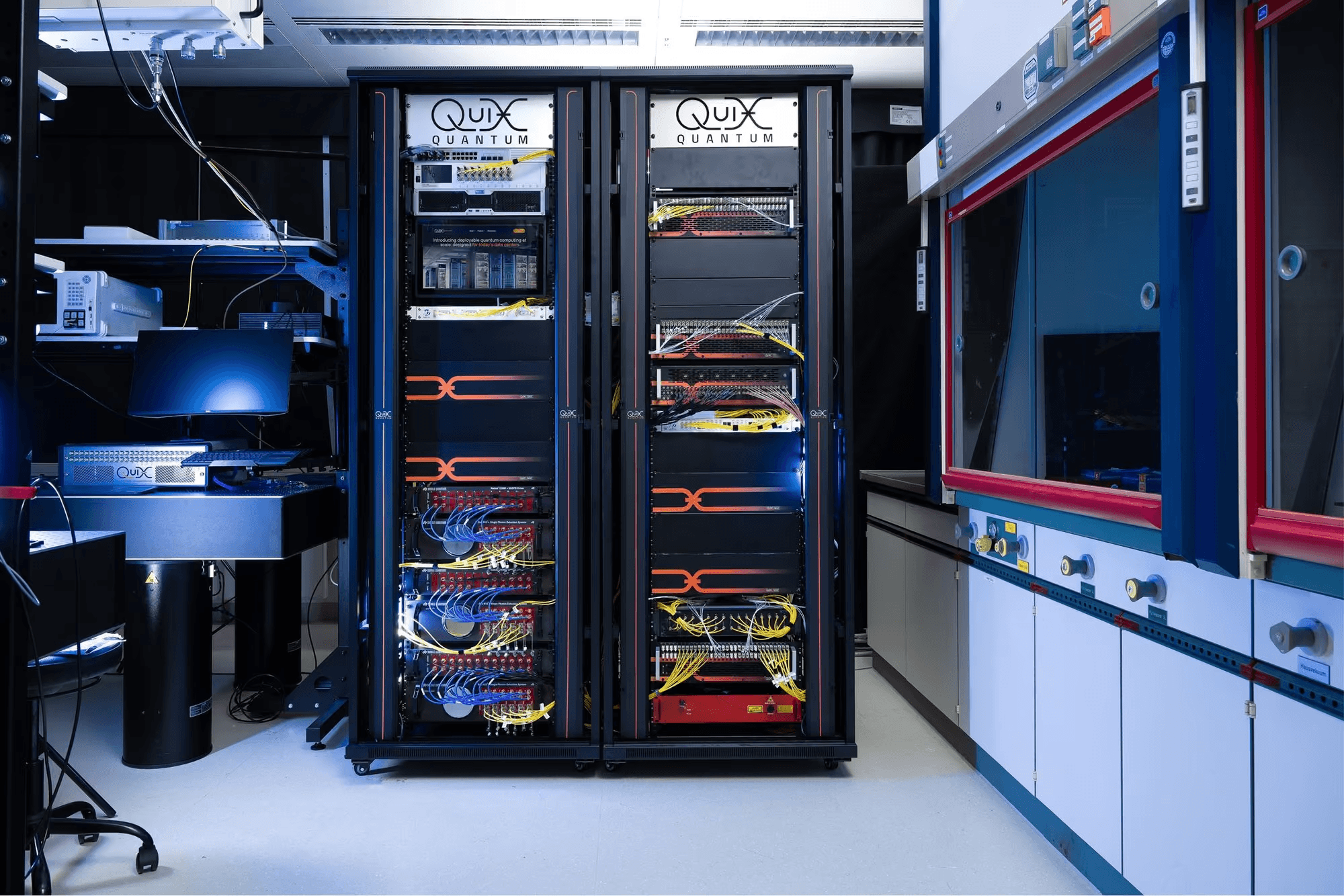
© QuiX Quantum

Team IO+ selects and features the most important news stories on innovation and technology, carefully curated by our editors.
QuiX Quantum, a startup based in Enschede, has become the first Dutch company to deliver a complete quantum computer to a customer, marking a milestone for Europe's young quantum industry.
The company announced two related developments on the same day: the unveiling of Carina, described as the world's first universal photonic quantum computing architecture designed for deployment in customer data centers, and the delivery of Carina's core hardware platform to the German Aerospace Center's Quantum Computing Initiative (DLR QCI) in Ulm, Germany.
.png&w=2048&q=75)
CEO Stefan Hengesbach called the milestone a shift "from component development toward system-level integration and validation in a real customer environment." The delivered hardware will now spend the coming months undergoing integration, calibration, and validation testing at DLR QCI before the system is confirmed to work as specified in the original tender. DLR had put the acquisition cost at roughly €14 million when it commissioned the project, though QuiX says the final price may differ since the design has since been revised several times.
What is special about QuiX's Carina?
Unlike most quantum computers, which rely on superconducting circuits cooled to near absolute zero, Carina uses single photons — particles of light — as its qubits. That allows most of the system to run at room temperature, avoiding the costly, energy-intensive cryogenic infrastructure that competitors depend on. The architecture combines photon generation, multiplexing, state generation, measurement, and high-speed "feed-forward" control into a single stack, and is built to run a universal gate set rather than the narrower computational models used in earlier photonic systems such as boson samplers.
A milestone for Dutch quantum computing
Founded in 2019 as a maker of photonic chips, QuiX spent nearly four years developing the system for DLR. The company designs its chips and components itself but outsources fabrication to specialized manufacturers, assembling the finished machine in-house.
Outside experts framed the delivery as a significant technical validation. Prof. Gerard Milburn of the University of Queensland, who co-authored the 2001 theoretical paper underpinning linear-optics quantum computing, said Carina shows that the approach "is not only tractable but navigable with integrated photonics." Philippe Bouyer, director of the Dutch quantum-sector organization QDNL, defined the delivery in an interview with FD as "an interesting milestone," adding that if DLR validates the system successfully, it would be "powerful evidence that Europe, and the Netherlands in particular, can deliver complete quantum systems."
The race to deliver quantum computers
Globally, most quantum hardware makers are targeting 2030 for machines capable of general-purpose use, and all are still wrestling with the same core problem: reducing computational errors as systems scale up. QuiX argues its photonic approach offers a more direct path to combining scale with reliability, and says Carina lays the physical groundwork for its next-generation "Dedalo" architecture, aimed at fault-tolerant, logical qubits.
Hengesbach said QuiX expects to deliver a substantially more powerful system by around 2030 — one capable of "meaningful applications," a term he acknowledged is vague but roughly means reliable operation without yet outperforming today's supercomputers. He also floated the possibility of QuiX eventually partnering with firms specializing in data-center installation as the company scales up against "big American tech companies."
Most Dutch quantum firms currently specialize in components — chips, electronics, cabling, or test equipment — rather than full systems. Delft-based QuantWare, for instance, recently raised €152 million to build its own chip factory. QuiX's delivery to DLR positions it, for now, among a small group of companies worldwide attempting to build and ship entire quantum computers.