
Robin Radar plays a cat-and-mouse game with smarter drones
Robin Radar uses radar and AI to stay one step ahead of drones in an increasingly complex game of cat and mouse.
Published on September 30, 2026
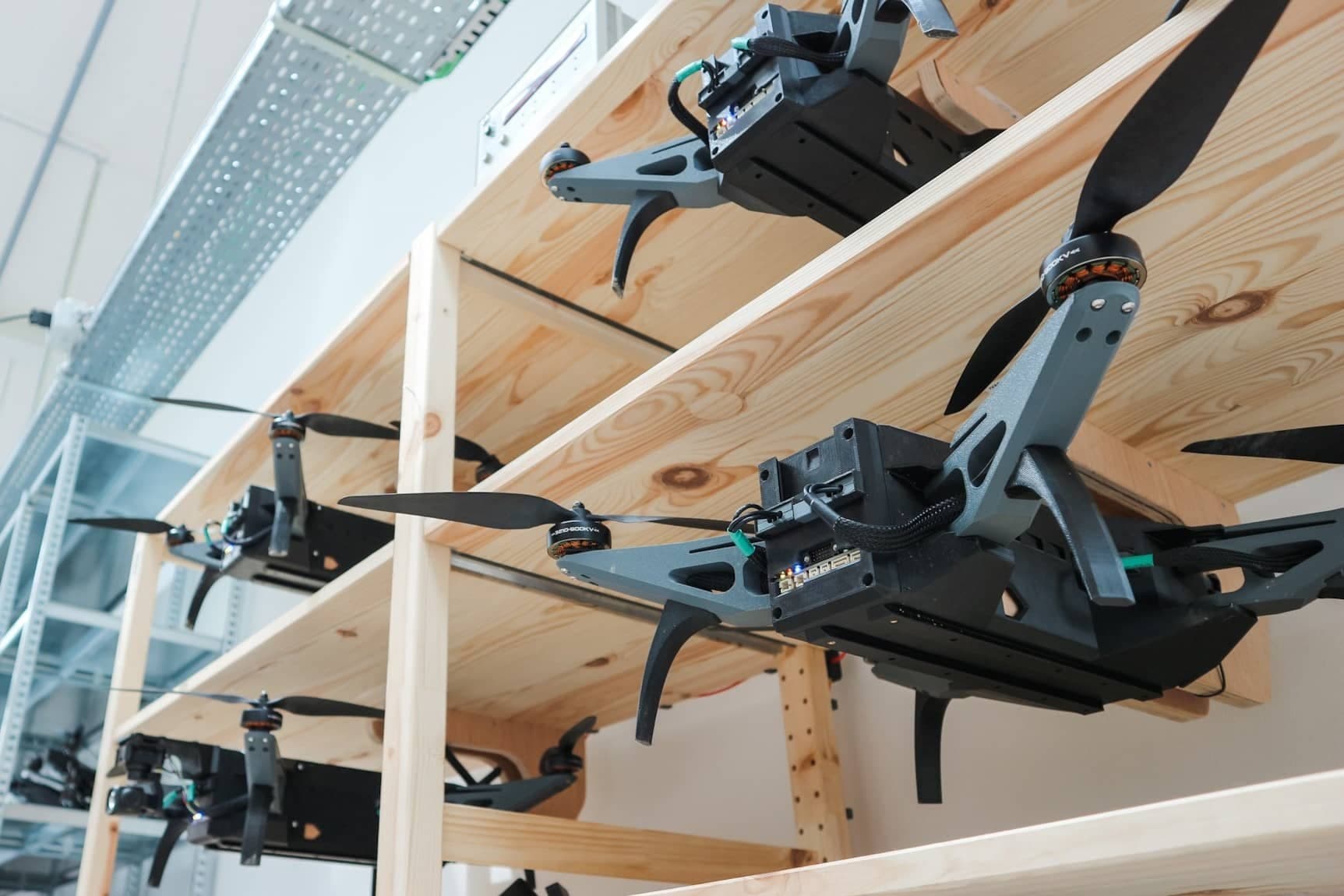
Drones are becoming smaller, smarter and more versatile. Scientists at TU Delft recently developed a drone that behaves like a bird, while researchers in the US have developed a drone that is almost invisible. This creates a new challenge for securing airports, power plants, military sites and other critical infrastructure: how do you detect a drone that you can barely see before it becomes a problem?
The Delft-based company Robin Radar Systems has an answer. The company began as a research project at research organization TNO to protect aircraft from bird strikes. Today, it supplies detection systems to defence and security organisations around the world.
Vivien Croes, CTO of Robin Radar, explains how the company uses fundamental physics and its own neural network to tackle an increasingly complex drone threat. “The only way to keep up in a constantly changing environment is to remain extremely agile ourselves.”
From TNO project to drone hunter
Robin Radar Systems began as a TNO research project in the 1980s and became an independent spin-off in 2010. The Delft-based scale-up specialises in detecting small airborne objects in complex environments, ranging from birds around wind farms and airports to drones near critical infrastructure and on the battlefield.
The move into drone detection began around 2012 with a practical testing problem. “You obviously can’t ask a bird to fly somewhere very precisely,” Croes explains. To validate the bird radar, the team flew test drones carrying a target designed to mimic the radar reflection of a bird. It soon became clear that the radar could detect the drones themselves as well.
After an initial prototype in 2015, the company launched its current flagship in 2020: IRIS, an advanced drone radar. “IRIS was first selected by Thales to help secure the Olympic Games in Paris,” Croes says. From 2022 onwards, as the war in Ukraine intensified and drones became widely used on the battlefield, demand from the defence and security markets grew sharply. That helped Robin Radar develop into the company it is today.
Pure physics versus camouflage
Technological developments in the drone industry are moving rapidly. Companies are experimenting with camouflage materials, whisper-quiet motors and drones that can even mimic the behaviour of birds. Yet Croes does not fear that drones will become invisible.
“It’s a cat-and-mouse game, but the advantage of radar lies in fundamental physics,” he says. “People use microphones to hear drones, so drones are made quieter. They use cameras, so drones are given camouflage. But there is one thing a drone will always have: mass. You need motors, propellers, and a battery to get somewhere.”
According to Croes, that is the fundamental limitation for any drone designer: “As long as an object has mass, it has a radar cross-section. That’s pure physics. You can reduce that cross-section through stealth techniques, but that is extremely expensive, and you can never reduce it to zero. Radar is not a magic solution, but it will always be a central pillar of a detection system.”
Micro-Doppler and self-learning AI
The biggest challenge in radar detection is not picking up a signal, but interpreting it correctly in a busy environment filled with trees, buildings, or moving water. To prevent false alarms, Robin Radar developed and patented its own neural network, called Deep Neural Network, in 2019. “Detecting and tracking is one thing, but where we really excel is classification,” Croes explains. “As an operator, you need to know for certain whether a dot on the screen is a drone, a bird or a helicopter.”
To make that distinction, the AI model analyses the so-called micro-Doppler effect: the small frequency shifts caused by moving parts within the object itself. “Our hardware is sensitive enough and our software powerful enough to look deep into the radar signal,” Croes says. This allows the AI to distinguish between the rotating blades of a helicopter, the propellers of a drone and the flapping wings of a bird.
Staying ahead in the cat-and-mouse game
As the threat in the air continues to evolve, the company believes the solution lies in continuously learning software. Robin Radar tests new drones through its own field trials and in collaboration with defence partners to collect data. By adjusting algorithms and retraining the AI model, existing radar systems can be updated remotely to detect new types of drones, without replacing any hardware.
As long as the drone threat continues to evolve, the technology needs to evolve with it. “The secret is not changing for the sake of changing, but listening very closely to what the end user needs and translating that into a working product as quickly as possible,” Croes says. “We want to remain a new type of radar company: technologically leading, but above all flexible enough to stay one step ahead of every next move in the cat-and-mouse game.”