
Smart beds, AI apps: flood of healthcare innovations at Jaarbeurs
Reporter Elcke Vels from IO+ attended the Zorg & ICT event at the Jaarbeurs.
Published on April 16, 2026

Our DATA+ expert and Editor-in-Chief, Elcke Vels, explores AI, cyber security, and Dutch innovation. Her "What if..." column imagines bold scenarios beyond the norm.
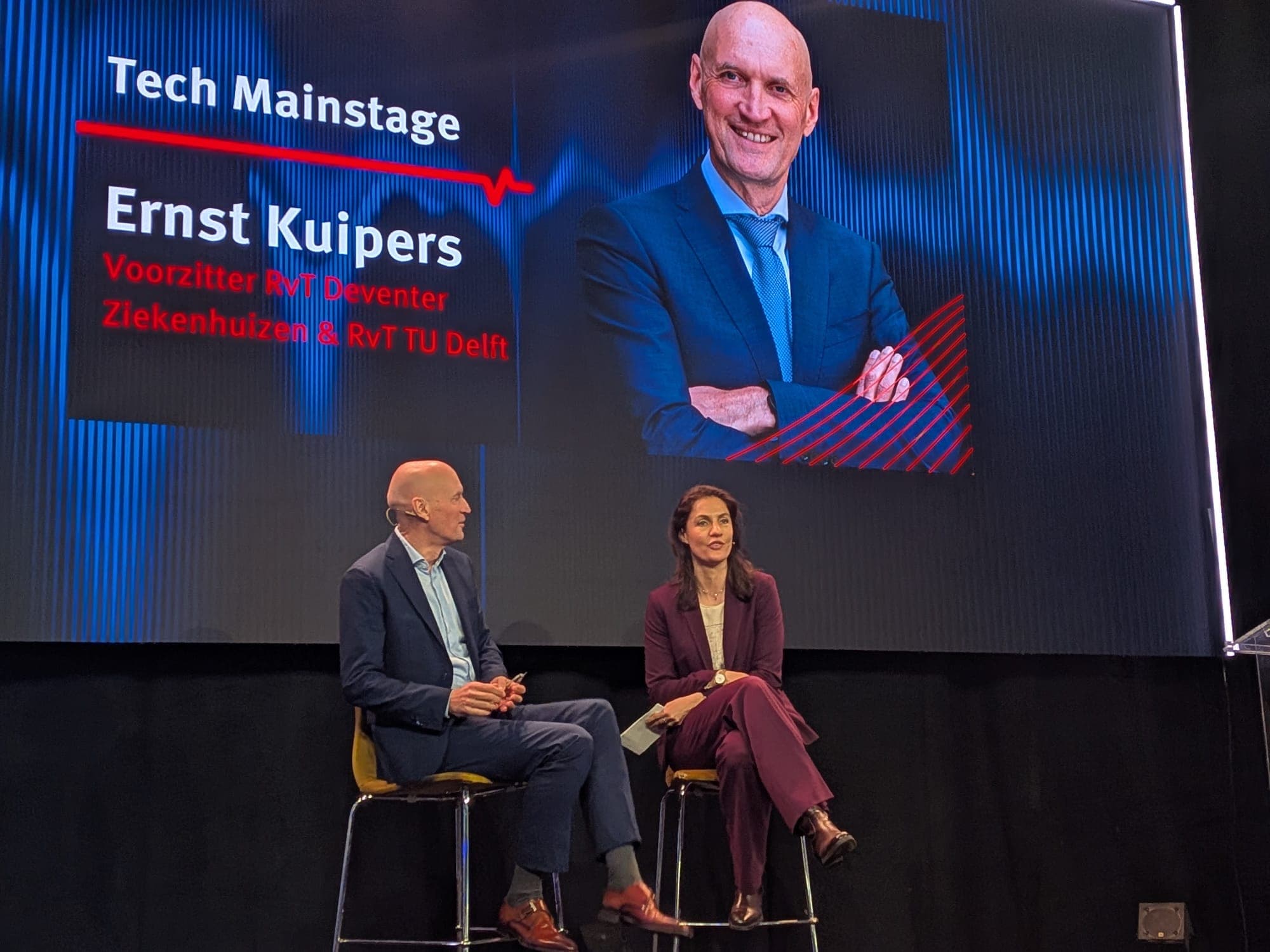
Smart beds, cleaning robot dogs, and countless AI-powered apps. IO+ reporter Elcke Vels attended the Zorg & ICT event at the Jaarbeurs, where the halls were filled with the latest technological innovations. The mood on the exhibition floor was optimistic, but the tone of the keynote speeches was critical. The most important lesson of the day: you can come up with wonderful technology for healthcare, “but that technology must actually relieve the burden on healthcare professionals,” says Ernst Kuipers during his presentation.
To my left, a robot dog walks past my leg. To my right, my gaze is caught by a hospital bed with a small screen. The amount of tech around me is quite overwhelming. I decide to walk over to Cinnovate’s hospital bed. The company’s employees explain how it works: “We have a care monitoring system for elderly care and disability care. A smart motion sensor can detect if someone, for example, sits up in bed. You then receive a notification about that in the system.”
Not long after, I strike up a conversation with someone from Orange Cyberdefence. The company provides cybersecurity services, including for the healthcare sector. A secure digital system has become indispensable for healthcare institutions, he explains. “A few years ago, people still said, maybe I’ll get attacked someday. Now we see: no, it’s going to happen—the only question is when.”
All I have to do is look in a certain direction, and I find myself in a lively conversation with an entrepreneur. About twenty of them have enthusiastically told me about what they’re so busy working on.
Lessons from Singapore
Enough chatter. Time to listen to Ernst Kuipers’ presentation. I take a seat in the front row near the main stage. Kuipers, former Minister of Health, Welfare, and Sport, and currently chairman of the Board of Deventer Hospitals and the Supervisory Board of TU Delft, opened the conference and engaged in a conversation with chairperson Danka Stuijver. They discussed promising technologies for healthcare.
Kuipers drew on his recent experiences in Singapore, where he worked at a technical university. There, he saw innovations that could fundamentally transform Dutch healthcare. Consider “smart fabrics” where the fibers of a shirt or sheet function as semiconductors. “Your clothing then becomes a sensor that continuously monitors your vital signs,” he explains. Miracles are also happening in the field of diagnostics, according to Kuipers, such as research into a single molecule in a blood cell, known as single-molecule research. This could revolutionize oncology, among other fields, by detecting tumors at an early stage.
Does technology help healthcare, or is it the other way around?
Numerous startups and scaleups in the Netherlands are busy implementing their technology in healthcare. According to Kuipers, however, we should only use technology if it serves a clear purpose. Juvoly came up in the conversation. That system instantly transcribes conversations with a patient into text and automatically generates a report. Kuipers shared a striking example that gets to the heart of the matter. “I recently spoke with two friends of ours who run a general practice together and are now using such a system. My question then was: does that also mean you schedule extra appointments per day with it? The answer was no. One might want to, but the other wouldn’t. While that, of course, should be the idea.” Kuipers is therefore not easily impressed by slick tech pilots, he says. According to him, every entrepreneur must dare to ask themselves: does this technology help healthcare, or is it the other way around?
Another danger discussed during the presentation is the pull effect of technology. Chairperson Stuijver, who is also a general practitioner, board member of VvAA, and columnist for De Volkskrant, cited the example of e-consultations intended to make healthcare more accessible. “In practice, this often leads to an explosion of trivial questions.” She heard stories about patients who sent photos of their sunburn from their vacation spot in South Africa, asking which after-sun lotion they should buy. “These kinds of questions now land directly on the general practitioner’s desk, causing them to lose valuable time on matters that have nothing to do with medical care,” she explains.
The network as a digital lifeline
Implementing technology correctly remains a challenge. The same goes for digital infrastructure, according to Kuipers. In the Netherlands, it is still not up to par. “Citizens need to gain much better insight into the data that is relevant to them.” He draws a comparison. “We can easily view our financial data in a bank app. When I was very young, there was a bank branch on every corner. You had to go there with cash. We haven’t done that in a long time, and we usually don’t need the bank at all.” It should be just as simple in healthcare.
Stuijver agrees. She also gives a striking example. “Yesterday I had a child in my office who needs a lot of medical care and regularly visits both the pediatrician and other healthcare providers. And the mother said to me: ‘We were at the pediatrician’s yesterday. I assume you can see that? Then I had to say: no, I can’t see that. And that surprised her enormously. Is this what healthcare will look like in 2026? I have to call the pediatrician first and transcribe what was discussed there.” So there is still much to be gained here.
I quickly realize that there’s also a lot of focus on the digital infrastructure of healthcare in other presentations and on the exhibition floor. After Kuipers, I take a seat in a small room a little further down the hall. I’m just in time for the presentation by IT consultant Wentzo. Two employees from the company explain that “the network is the lifeblood of healthcare these days.” Everything—from looking up patient information in the EHR to smart sensors that detect if a patient has fallen out of bed—runs through that network.
However, many healthcare institutions are still grappling with a legacy of outdated and complex systems. That lack of visibility leads to security risks and inefficiency. Wentzo, therefore, advocates a transition to modern architectures, such as SD-WAN, where network traffic is intelligently and centrally managed via software, allowing you to flexibly determine which traffic gets priority and over which connection it runs.
Opportunities and challenges
I leave the trade show with the feeling that healthcare is in the midst of a digital transition, full of opportunities but also significant challenges. I am particularly curious to see whether the technology being presented here today will have made a real difference by the time I visit the trade show next year.
Here’s to next year.