
The art of innovation sometimes lies in what you leave out
In a series of blog posts, Marco Coolen offers a glimpse into his work as a Dutch and European patent attorney at AOMB.
Published on September 27, 2026

Marco, a patent attorney at AOMB since 2013, shares his expertise on IO+ about patents—how they work, why they matter, and when they lose their value.
When people think of innovation, they usually think of “more.” More features. More technology. More possibilities. More parts. But sometimes the greatest innovation lies precisely in the opposite: in taking something away.
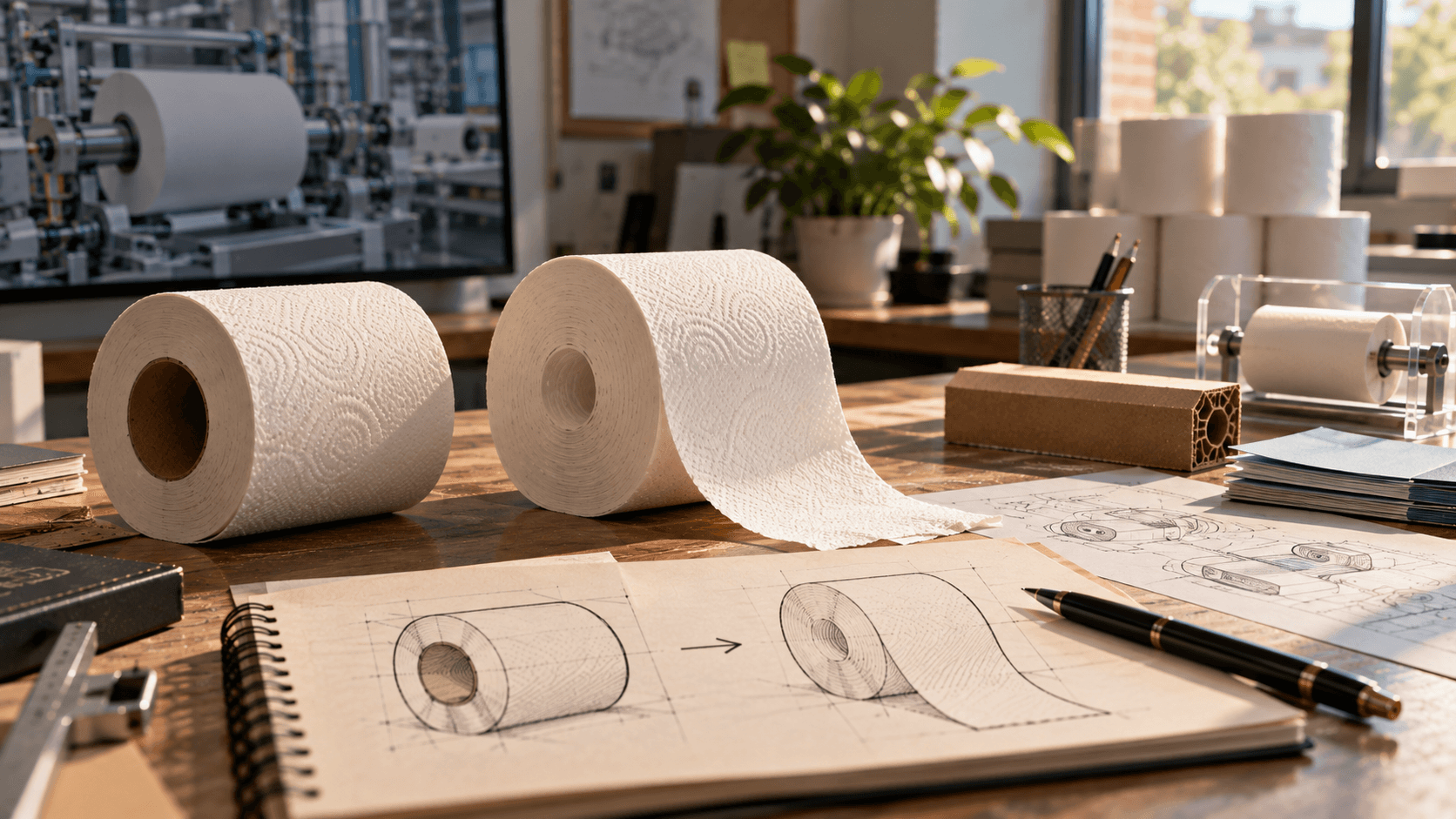
Take toilet paper without a cardboard tube. At first glance, that hardly sounds like innovation. Less waste, a little more paper on the same roll, and that’s it. The kind of improvement you might dedicate a press release to, but not a tech story. Yet the reality turns out to be a lot more interesting.

Marco Coolen, photo © Bart van Overbeeke
Essity introduced Edet Smart to the German market in 2025. The Netherlands will follow in 2026. Interestingly, the underlying technology has been around for much longer. The first efforts to protect this concept date back several years.
That time lag actually tells the most interesting part of the story. Because as soon as you remove the cardboard core from a toilet roll, you’re not just getting rid of a piece of trash. You’re removing the structural backbone of the product. That cardboard tube ensures that the roll retains its shape during production, transport, storage, and use.
Without that core, the paper itself has to do the work. And that turns out to be surprisingly complicated. The roll must be sturdy enough not to collapse. It must unroll neatly without tearing. It must withstand pressure in packaging and during transport. At the same time, consumers expect exactly the same experience as with a traditional roll.
No one wants a sustainable product that falls apart the moment you pick it up. That means all sorts of details have to be redesigned: the tension between the layers of paper; the way the material is wound; the structure of the paper itself; the position of adhesive joints; even the embossed pattern plays a role in the strength of the final construction.
What appears to the consumer as a minor adjustment turns out to be a complex technical challenge behind the scenes. That is precisely why this is such a great example of innovation—not because the idea is spectacular, but because the execution is. Even more interesting is how companies protect such developments. The value rarely lies in a single patent covering the big idea. Much more often, a network of protection emerges around all the practical challenges that need to be solved.
Not just the coreless roll, but also the production method, the winding technique, the material composition, the processing in dispensers, the logistics, and the quality control. Each individual component may seem small. Together, they form a system that is difficult to copy. This also explains why there are sometimes years between a technical discovery and a market launch. That period is not a delay. It is the phase in which technology, production, protection, and commerce converge.
Many innovations fail because one of those components lags behind. Successful innovations, on the other hand, are given the time to mature as a whole. The lesson, therefore, is surprisingly simple. Innovation isn’t always about adding something that didn’t exist before. Sometimes it’s about removing something everyone thought was indispensable. And that’s precisely when the real engineering work begins.
The World of Patents
With the help of Dutch and European patent attorney Marco Coolen (AOMB), we can better understand the world of patents. How do they work, why are they important, and when do they lose their usefulness?