
The solar era is already here. Now comes the hard part
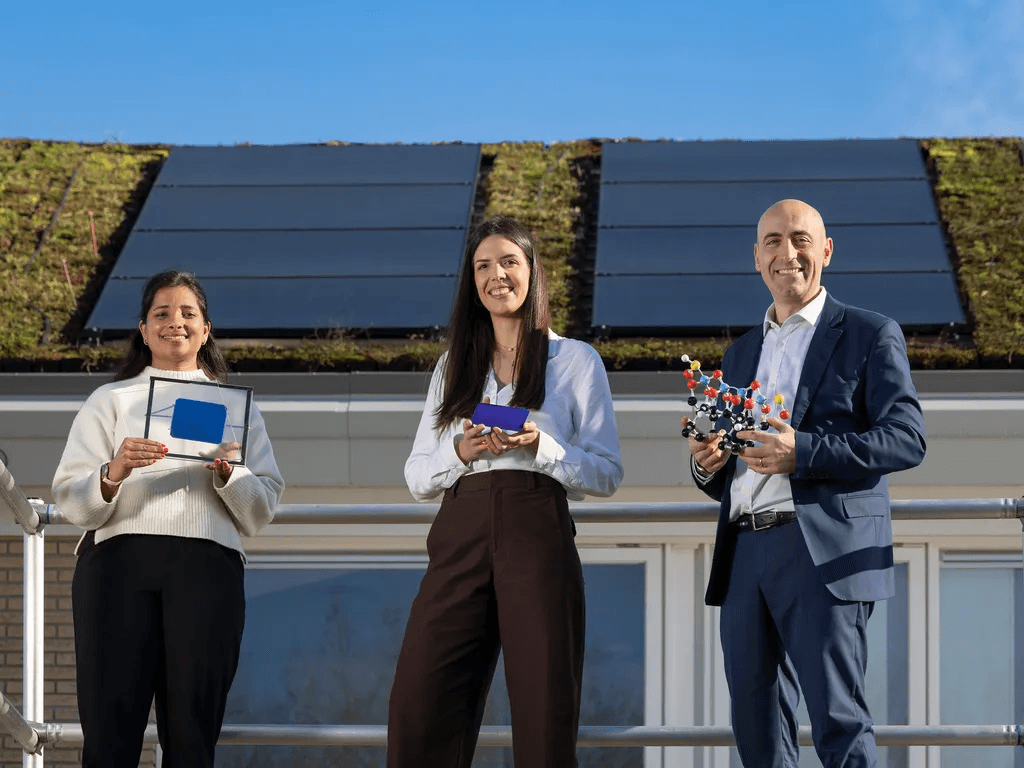
Inside Delft University of Technology’s solar labs, where the panel of the future is already on the table.
Published on June 5, 2026
© Delft University of Technology

Mauro swapped Sardinia for Eindhoven and has been an IO+ editor for 3 years. As a GREEN+ expert, he covers the energy transition with data-driven stories.
Solar energy is undoubtedly the enabler of the global green transition, given its extremely low cost — as little as €0.023 per kilowatt-hour. "Last year, the world added the equivalent of roughly a thousand nuclear power plants' worth of solar capacity. Building a nuclear power plant takes up to fifteen years and requires major government commitment. With solar panels, we add each year an amount of energy capacity comparable to a thousand nuclear power plants,” says Professor Olindo Isabella.
He leads the Photovoltaic Materials and Devices (PVMD) group at the Delft University of Technology (TU Delft). The group focuses on the full solar energy chain, from the atomic physics of a single thin-film layer of solar material to the kilometer-scale modeling of floating solar farms.
.png&w=2048&q=75)
During a press tour organized by the university attended by IO+, the researchers opened their labs to show the status of their research. The message that resonated throughout the day is clear: the solar revolution is already here. The hard part is everything that comes next.
Smarter, greener, and circular
Isabella’s group is working on three main challenges: materials, intelligence, and circularity. Standard solar cells contain silver for electrical contacts and indium in their transparent layers. These materials are scarce and, in some cases, environmentally problematic.
The professor shows an alternative solar cell with an orange hue: copper, which the group has successfully substituted for silver without any loss of efficiency. "We need to move towards materials that are more abundant and less toxic," Isabella says. "And this is what is being done here."
As per intelligence, the Delft group is trying to go beyond the conception of the solar panel as a passive device: light in, electricity out, with no possibility of responding to what is happening around it. Researchers developed a junction box — a plastic component that attaches to the back of a solar module – which dynamically reconfigures how each cell is connected depending on shading conditions.
On a rooftop where a tree casts a moving shadow, for instance, the box keeps the solar panel operating optimally at all times. In essence, the box continuously monitors how much electricity each cell in the panel is producing. When it detects a mismatch — because part of the panel is in shadow — it physically reroutes the connections between cells to get the best possible output from what is available.
In this way, the system also prevents so-called thermal hotspots. These heat concentrations on a specific spot of the panel can shorten a panel’s life and, in extreme cases, lead to a fire. "By design," Isabella says, "the module never enters the situation where a hotspot can occur."
It is time to act on the grid
As the price of solar panels keeps dropping, what is the value of pushing the costs of module manufacturing further down? According to the professor, the real problem is elsewhere, not in the costs of generating electricity but in the grid.
Europe’s electricity infrastructure was designed for power to flow in one direction — from power plants to consumers. Yet, the rise of renewables means that production is widely distributed. "The technology is ready," Isabella underlines. "What is needed is a strong government commitment to adapt the grid."
This commitment means a clear strategy to couple renewables deployment with storage, as well as integration of software to make the grid smarter. The professor acknowledges that more investments are needed to increase capacity on the electricity grid – something that grid operator Tennet is already doing, he says — but that the scale is immense and that takes time.
The growth in solar electricity generation that the Netherlands experienced in recent years was almost entirely economic, according to the professor. Solar panels became cheaper, and deployment was rapid and widespread. Batteries, he predicts, are on the same trajectory. A 3 kWh home battery already costs around €2,500–3,000. "Both technologies are ready. The question now is just making sure every new photovoltaic system comes with a battery."
More efficient, sleeker solar cells
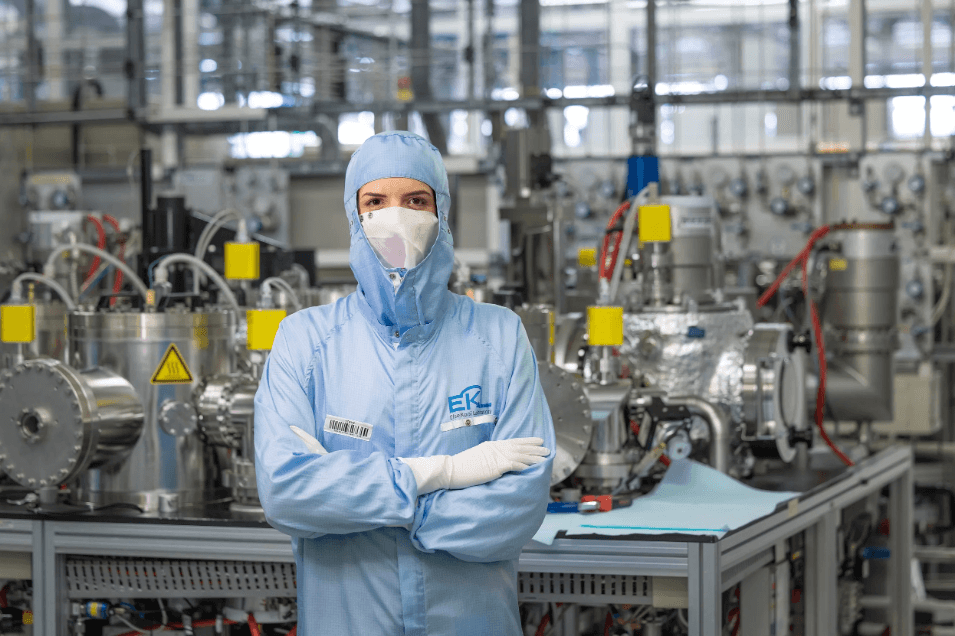
Among the researchers Isabella introduces is PhD Katarina Kovačević, whose work addresses one of the more counterintuitive problems in solar cell design. The metal contacts on the front of a conventional silicon cell are, by necessity, blocking the very thing the cell is trying to capture. Every silver busbar printed across the illuminated surface casts a small shadow, and across millions of cells, that adds up.
Her research thus focuses on back-contact solar cells, where electrical contacts are placed on the rear. The result is a more efficient and more visually appealing solar panel. Without metallic gridlines, the cells take on a smooth, near-black appearance that integrates far more naturally into roofs and facades than the blue, grid-lined panels most people picture. This technology has existed since the 1970s, but has yet to see broad application.
The group has pushed this further by introducing nanoscale surface roughness on the front that makes the cells even darker — a trick, Kovačević notes, that certain bird species use on their feathers for exactly the same optical effect. The designed solar cell achieved a 24% efficiency — close to that of conventional solar panels.
Katarina Kovačević in her lab coat - © Delft University of Technology
A solar energy future
Electrification of society calls for qualified engineers to design tomorrow's solar parks, batteries, and grids. In addition to their research, the academics are teaching the next generation of engineers at the university. After the presentations, the tour moves downstairs to the PV Education Lab.
Lecturer Robin Vismara illustrated the facility, where students get a full understanding of solar technology. From the single solar cell to the interconnected rooftop systems with batteries and inverters.
Outdoors, next to the lab, there is also an array of solar panels that, despite the overcast sky, continue to produce electricity, Vismara notes. “It is not a coincidence that the Netherlands is the country with the highest solar watt capacity per capita. It works, even on a day like this,” he adds.
Back upstairs, Isabella is asked what the Netherlands might look like energetically in ten years. He doesn't hesitate. Solar will be everywhere — on roofs, facades, water surfaces, farmland — paired with batteries, feeding a grid that has finally caught up with the generation it needs to absorb. The technology, he repeats, is not the constraint. It never really was. "The sun," he says, "is not going anywhere."