
The Wright brothers didn't sell an airplane
In a series of blog posts, Marco Coolen offers a glimpse into his work as a Dutch and European patent attorney at AOMB.
Published on July 5, 2026

Marco, a patent attorney at AOMB since 2013, shares his expertise on IO+ about patents—how they work, why they matter, and when they lose their value.
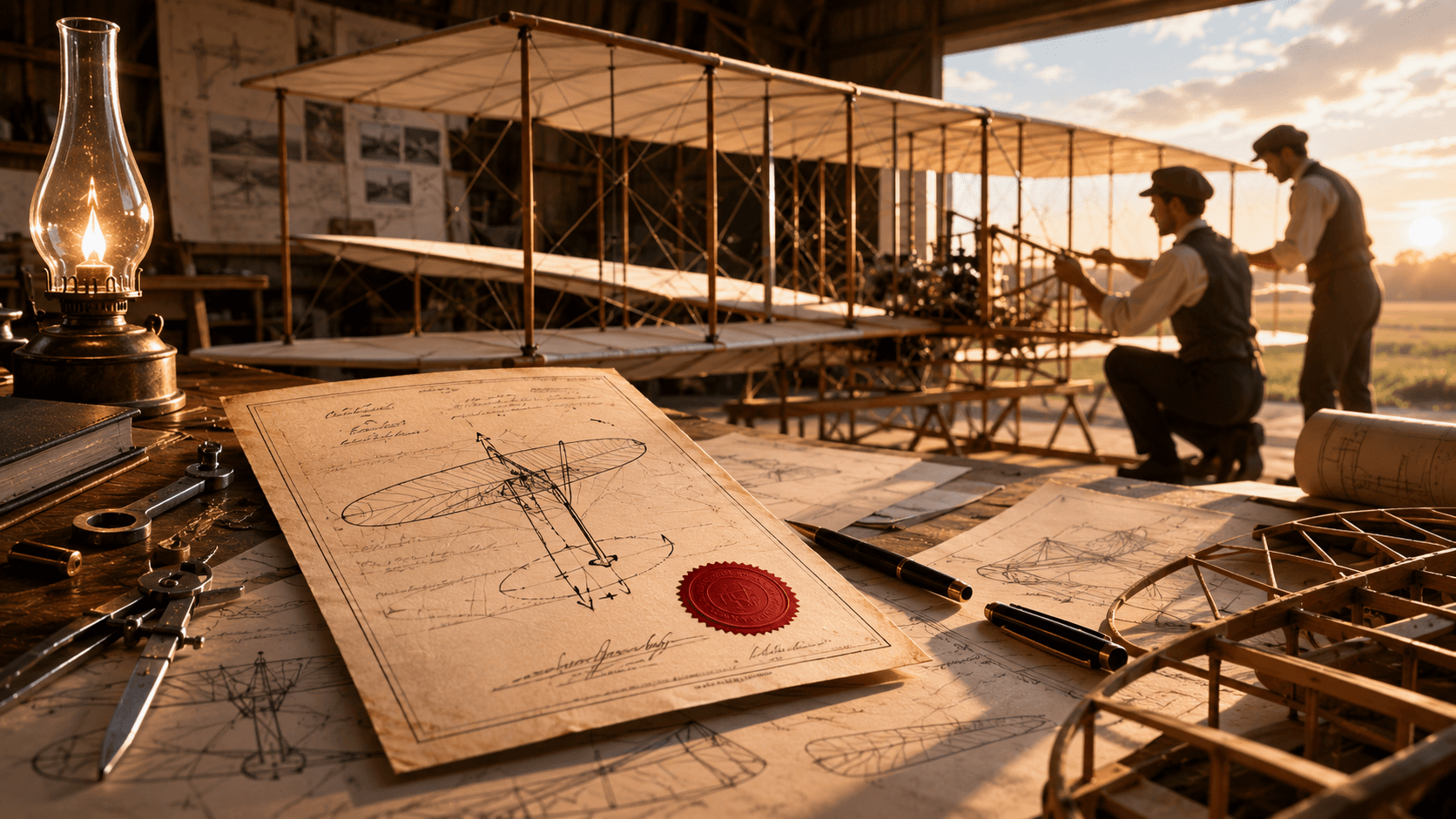
123 years ago, the Wright brothers filed their first patent application.
That’s remarkable, because the first successful powered flight had yet to take place. They were already experimenting extensively with gliders—testing, measuring, and making adjustments. Every flight yielded new insights. Step by step, they got closer to something no one had ever truly mastered before: controlled flight.
.png&w=2048&q=75)

It was precisely during that phase that they decided to file their first patent application—not for an aircraft, but for the principle that made flight controllable. They protected the core of their innovation—what we would call a basic patent today. This protection was so fundamental that competitors could hardly get around it.
At the same time, they were remarkably cautious. They retreated to remote test sites, kept their progress out of the public eye as much as possible, and were selective about whom they involved in their work.
Not because they wanted to be secretive. They understood something that many entrepreneurs still underestimate today: a good idea only gains value when you reveal it at the right moment.
Protection Does Not Equate to a Market
The Wright brothers financed their experiments entirely on their own. There were no investors demanding quick results. No quarterly targets. No pressure to go public as soon as possible.
That freedom gave them the opportunity to continue developing their technology at their own pace. But even with a strong patent in hand, success was by no means guaranteed. In the United States, they initially struggled to sell their technology. The enthusiasm they had expected failed to materialize. So they looked beyond their home market and eventually ended up in France, where interest proved to be greater.
There, they ran into a new problem. How do you sell something without explaining exactly how it works?
Every Innovator’s Dilemma
This tension is surprisingly relevant today. Virtually every innovative company faces it sooner or later. You want to convince customers. You want to inspire investors. You want to attract partners. But at the same time, you don’t want to reveal all the technical details.
Many entrepreneurs therefore believe that their technology is their most important selling point. But that’s usually not the case. Customers rarely buy technology. They buy a solution.
The technology isn’t the story
The Wright brothers didn’t ultimately sell an airplane. They sold something much bigger: a new way of traveling. Their customers weren’t interested in wing deformation, steering mechanisms, or aerodynamic principles. They wanted to know what that technology made possible.
Faster travel. New connections. New opportunities. The technology made that possible, but it wasn’t the proposition itself. And that’s still true today. A customer doesn’t buy an algorithm. Not a sensor. Not a coating. Not a production method. A customer buys a problem that goes away.
The Real Lesson
Many entrepreneurs rightly devote a great deal of attention to protecting their innovation. But protection alone does not create a market. A patent can safeguard your technology. It can keep competitors at bay and give you a strong position. But ultimately, something else determines success. The technology gets you off the ground. The value proposition determines who gets on board.

The world of Patents
Every Sunday, Marco Coolen gives us a glimpse into the world of intellectual property and patents.