
TomTom’s New Route Runs Through AI
TomTom opens its doors to the press, revealing a world where maps no longer guide people, but primarily navigate AI and machines.
Published on September 8, 2026
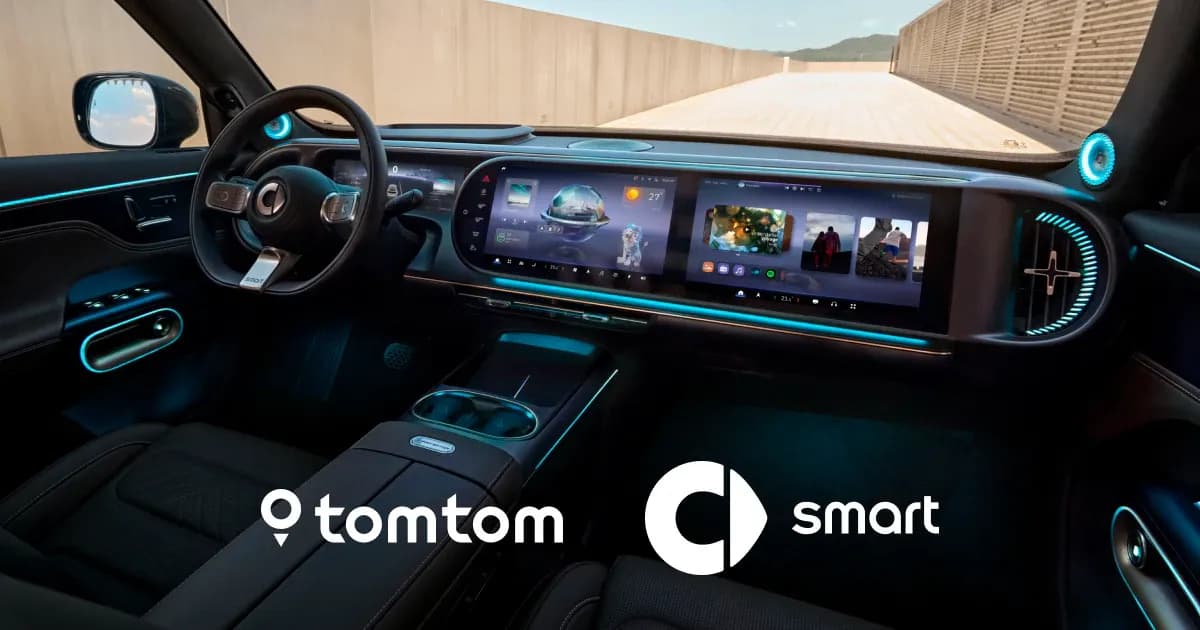
Maps, AI models, the Orbis platform, and automated driving: where TomTom previously kept ranks closed to the outside world, the tech company swung its doors wide open last Thursday. During a dedicated press morning—the TomTom Discover Event at its headquarters—Managing Director Mike Schoof provided an inside look into the company's strategic repositioning.
This shift revolves around a fundamentally different challenge than the one it pursued for forty years. Schoof summarized the transition: "For forty years, digital maps helped humans understand the physical world; the next opportunity is to help intelligent systems and AI understand that physical world and move within it." Consequently, TomTom is betting heavily on automated driving technology, aiming to provide the critical safety layer for more than half of all new European cars by 2030.
The Core
No more heavy investments in dashboard screens or other hardware, but a radical focus on the core. "Our core is that we own the data, with our location intelligence layered on top as an additional information layer," Schoof explains. The company wants to steer clear of minor distractions and concentrate on its core strengths. In short: the focus is shifting from hardware to software.
TomTom's transformation is clearly reflected in the numbers. Taco Titulaer, CFO of TomTom, explains: "Where the company in its heyday relied on navigation devices with physical margins around 40 percent, it now operates as a pure software company with gross margins heading toward 90 percent."
The linchpin of this transition is Orbis, TomTom's AI-native map infrastructure that acts as the 'ground truth': a uniform, verified reference reality of the physical world upon which both self-driving cars and geospatial software agents can reliably base their decisions.
Two Markets
TomTom is going all-in on automated driving technology. While modern sensors and cameras have a limited field of view, a detailed map eases the burden on the onboard computer by delivering static road information ahead of time. "With the intelligent map, the car no longer drives around like a tourist, but like a local who knows exactly where to go," notes Leo Sei, Chief Product Officer at TomTom.
Second, TomTom is focusing on location intelligence for enterprises, governments, and AI agents. This market is growing at a double-digit annual pace and it is estimated that roughly 70 to 80 percent of all enterprise data contains a spatial component. This data is now made directly machine-readable for software agents. Governments and platforms like Flow Labs use the real-time traffic and intersection data to dynamically optimize traffic lights. Even national security agencies are coming on board: the Australian Geospatial-Intelligence Organisation (AGO) integrated TomTom's standardized dataset directly into its operational systems for secure mission planning and logistics.
Future Returns
Whether this new strategic direction can ultimately match the record revenue of 1.7 billion euros achieved in 2007 is something CFO Taco Titulaer hesitates to predict. "Back then, we entered a market that didn't exist yet, and we never foresaw it becoming such a massive success," he reflects. "Sometimes it's very difficult to pick a market that doesn't exist today. But we see significant opportunities."