
TU/e's Tech Transfer Challenge crowns its first winner
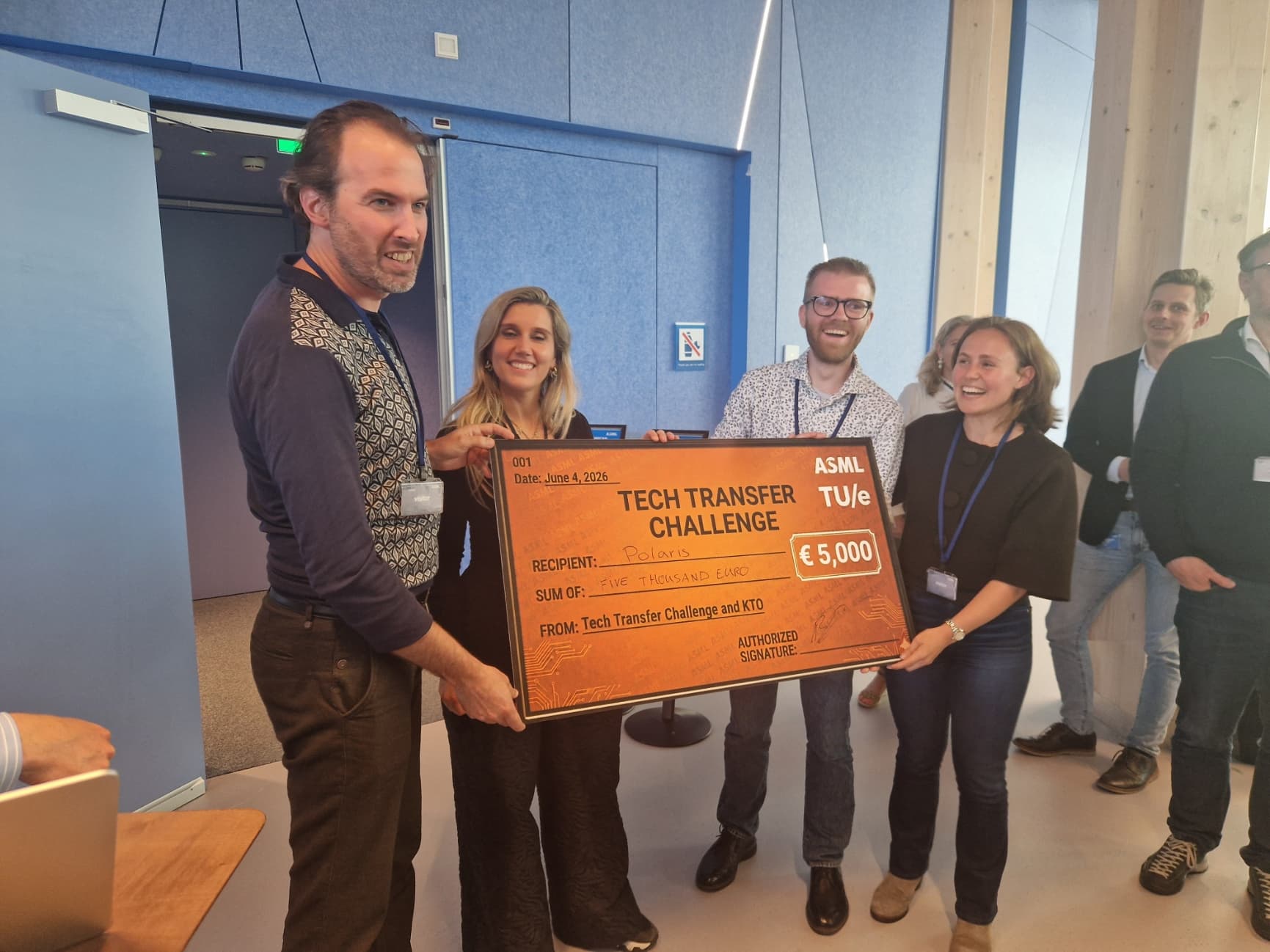
Polaris, a real-time guidance system for carotid ultrasound, won the inaugural TU/e Tech Transfer Challenge at ASML.
Published on June 6, 2026
© IO+

Mauro swapped Sardinia for Eindhoven and has been an IO+ editor for 3 years. As a GREEN+ expert, he covers the energy transition with data-driven stories.
"In the university labs, there is a lot of untapped potential, often invisible to the outside world." With those words, organizer Boudewijn Docter captured the spirit of the Tech Transfer Challenge (TTC) — a competition for Eindhoven University of Technology (TU/e) researchers that culminated in a Grand Finale at ASML, where six finalists pitched ideas that could one day become companies.
One of those ideas could save lives during the critical hours after a mini-stroke. When a patient suffers a Transient Ischemic Attack (TIA), a carotid ultrasound must be performed as quickly as possible — the risk of a disabling stroke is highest in the hours immediately after. But training a sonographer takes years, and Dutch hospitals only offer the exam for a limited number of hours a day.
.png&w=2048&q=75)
Polaris, pitched by TU/e PhD candidate Noortje Schueler, tackles that bottleneck head-on: a sensing unit mounted on the ultrasound probe provides real-time feedback, guiding the operator through the exam by matching the live image to an existing dataset. The judges were convinced. Polaris walked away with the €5,000 first prize.
“Taking part in the TTC has been a moment of growth for us,” says Schueler after the win. “They gave us a lot of guidance and knowledge on how to potentially translate this research into a company. Coming from academia, being exposed to the ideas and being challenged by experts with a different background makes you think of aspects of your idea you didn’t think of.”
© Bert-Jan Woertman
From lab to pitch stage
The TTC involved TU/e PhD candidates, postdocs, and researchers, aiming to help them assess the commercial potential of the technologies they work on in university labs. The journey began in March with the first 100-word submissions and culminated in the June 4 final.
Throughout these months, participants had a chance to network with entrepreneurs, investors, and coaches. In a way, they had a feel of what starting a path in entrepreneurship might look like and what it takes to make a scientific breakthrough an impactful company.
The competition was supported by the TU/e’s Knowledge Transfer Office (KTO), ASML, Brainport Eindhoven, the G&A Foundation, Braventure, DeepTechXL, and the University Fund Eindhoven.
The final stage of the competition saw the finalists pitch their ideas to a jury of founders, investors, and innovation experts. Following their presentation, the judges had some time to ask the budding entrepreneurs questions.
A valuable challenge
“Innovation is what we build; we do it internally, but we also want to make sure that around us, there is a lot of innovation happening,” said Evelien de Vries, partnership manager, startups and venture capital at ASML.
For TU/e's Knowledge Transfer Office (KTO), the value runs even deeper. Renato Calzone, head of TU/e’s KTO and a jury member, was particularly impressed by the pitches’ quality and also praised the collaboration with the TTC initiators, Boudewijn Docter and Tienko Rasker. “I am happy they approached us and that we successfully collaborated in creating the TTC. As KTO, we want to be a collaborative organization, not only towards the university but also to the outside world. Initiatives like this help push impactful innovation out of the labs.”
The other finalists
Gelion Care presented an innovative gel for wound healing of diabetic foot ulcers, a diabetes complication that, in its severest forms, can lead to amputation. The team has found a way to encapsulate nitric oxide — an agent that has proven effective in wound healing — in a hydrogel, ensuring drug release where it is needed most.
PFAS Free pitched its solution for cleaning wastewater streams from ‘forever chemicals’, artificial compounds known as polyfluoroalkyl substances. These compounds, found in coating industrial units as well as in cooking pans, pollute the environment and pose a hazard to human health. The team has developed a process that, after concentrating PFAS, can break them down in a plasma reactor, cleaning water effectively.
RAPID introduced technology to enable real-time interactive applications in 5G and 6G networks. Their software can keep real-time applications responsive, without any change to the infrastructure or standards. The protocol can be useful in teleoperation use cases, as well as in remote and autonomous driving applications, ensuring devices can be operated remotely and autonomously.
ORIONN is working on hardware and software to solve optimization problems in industry. From logistics to manufacturing, companies face optimization problems in their daily operations. The team’s solution offers them a way to respond to these challenges and solve them promptly and adaptively.
ARIES (Adaptive Robotics In vitro Engineering System) is developing a bioreactor to engineer functional ligament tissue. Current ligament repair options can restore function but never restore a native ligament, resulting in a trade-off. The proposed bioreactor, instead, would allow care centers to grow their own tissues as needed and provide patients with a fully biological ligament.
From the labs to the real world
The Tech Transfer Challenge will be back next year. Although the initiators specify that not every idea must turn into a successful startup, the competition is a way to learn, experiment, and fail. And if even only one of the six ideas will eventually result in an impactful startup, the result will be achieved: making sure research finds its impact in the real world.