
Ventuno: bicycle efficiency with car-Like comfort
With the “Ventuno,” Urban Mobility Group is introducing a safe and innovative mode of transportation for commuting.
Published on October 19, 2026

Merien co-founded E52 in 2015 and envisioned AI in journalism, leading to Laio. He writes bold columns on hydrogen and mobility—often with a sharp edge.
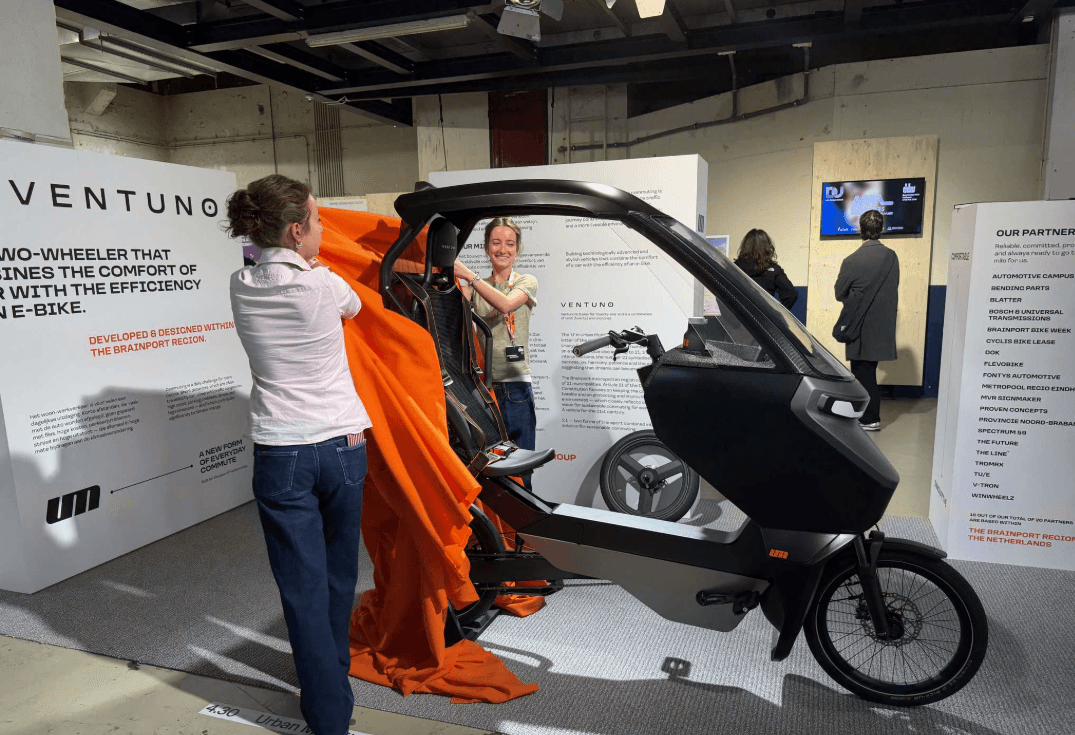
A hybrid two-wheeler that combines the safety of a car with the efficiency of a bicycle. That’s the concept Urban Mobility Crew is presenting at Dutch Design Week in Eindhoven. The vehicle, equipped with a roll cage, seat belts, and V2X connectivity, is designed to make commuting faster, safer, and more sustainable. Starting in the Brainport region, this is set to become an attractive alternative to the car.
A new category
Commuters are flocking to their cars for trips of barely twenty kilometers, often purely out of a need for a roof over our heads and a sense of security. But there’s no room for all that metal. Many of those drivers will also readily admit that the bicycle is often a smarter choice. But the bicycle has its drawbacks, too.
Edwin Heesakkers, the mastermind behind the Ventuno, noticed that while the Dutch market is flooded with over 140 e-bike brands, they all essentially build on the traditional bicycle frame. He decided to turn that on its head: what if you designed an e-bike from the perspective of a car driver?
The result is a vehicle that replicates the safe cocoon of a car on two wheels. The Ventuno is equipped with a sturdy roll cage, four-point seat belts, and a canopy. Yet it is emphatically not a glorified microcar or a wide micro-vehicle—a category for which cities like Amsterdam are now closing off bike paths. With a modest width of seventy centimeters, the Ventuno is even narrower than an average cargo bike. So you can ride it completely legally and smoothly along the bike path, while simply bypassing the daily traffic jams.
Space and efficiency
However, the bike path itself is getting busier these days. Navigating between wide cargo bikes and fast fat bikes, space has become a precious commodity, and maneuverability is essential. It is precisely in these crowded conditions that the Ventuno’s sleek design proves its worth compared to larger alternatives. Thanks to the fast F-bike paths being rolled out across the region, you’ll simply reach your destination faster on trips of up to about fifteen to twenty-five kilometers.
That switch from four to two wheels delivers not only time savings but also a massive efficiency gain. Whereas a typical electric car has to move about 2,000 kilograms of steel and batteries to transport a single person, the Ventuno weighs just over 50 kilograms. That ratio makes this hybrid two-wheeler up to fifty times more efficient than an electric car.
Smart V2X connectivity
Since comfort today goes beyond simply staying dry, the vehicle is equipped with modern automotive technology. Thanks to V2X (Vehicle-to-Everything) connectivity, the Ventuno will soon be able to “communicate” with road infrastructure and smart traffic lights. To get these kinds of innovations off the ground, Urban Mobility Group relies heavily on the innovative strength of its own region. Of the twenty development partners, sixteen are from the Brainport region, including Bosch, the Automotive Campus, V-tron, and TU/e.
Those deep regional roots are also reflected in the name. Ventuno is Italian for twenty-one: a subtle reference to the twenty-one municipalities that together form the Brainport region, but also a literal nod to “two-in-one” mobility. With this, Heesakkers may well be closing a circle that had been open in Eindhoven for a very long time. Over a hundred years ago, Philips pioneered the world’s very first e-bike here, but that project fell through because it wasn’t allowed on public roads. Today, the Ventuno brings that age-old ambition back to the streets, specially designed for the 21st-century commuter.